In 2026, the United States and Iran went to war. But that is not the only war between these adversaries, and perhaps not the one that matters most.
Executive Summary
Read the executive summary
In 2026, the United States and Iran went to war. But that is not the only war between these adversaries, and perhaps not the one that matters most. The other is older, quieter, and has no ceasefire: an information war Iran has waged against the United States since the 1990s, a sustained campaign aimed at dividing American society and turning its citizens against one another and the state. The first war is fought with weapons. The second is fought with narratives, and the central narrative is antisemitism.
The West has misread that second war from the start. Iran’s antisemitism looks, from the outside, like the reflexive bigotry of a hostile regime, a matter for civil-rights monitors and interfaith panels. That reading is wrong. Iran’s antisemitism is not a sentiment, but a method, a precision instrument aimed at the United States, refined over three decades, and designed to turn the country’s own citizens into carriers of a foreign state’s narratives. It runs through conference halls and film festivals, through news outlets and a constellation of websites that pose as independent journalism, through hackers and fake personas and the open-editing pages of Wikipedia. It has reached tens of millions of Americans, subtly shifting what they accept as fact.
This report documents that campaign: who built it, how it works, why it succeeds, and what it will take to stop it.
Why Antisemitism
Why wage that war through antisemitism? Because it is the one narrative that crosses every ideological border. The same claim about Jewish or Zionist power can be sold as anti-imperialism to the radical left, as civilizational defense to the religious right, and as racial grievance to Black nationalists. Nothing else unites a white nationalist, a campus socialist, and a Christian fundamentalist around a single enemy the way antisemitism does. Iran did not invent this kind of warfare (which it inherited from Soviet and Russian tradecraft), but it sharpened the method and gave it a name: soft war, the effort to defeat a stronger enemy not on the battlefield but in the minds of its people.
An Infrastructure Built Over Decades
The campaign is not, at bottom, a digital one, and that is the finding with the greatest consequences for anyone hoping to counter it. It rests on a human network built slowly, in person, over decades. It began in a series of conferences in Tehran that did what no algorithm can, strategically placing people in rooms who would never otherwise meet, among them a Holocaust denier and a Black nationalist, a neo-fascist and an anti-war activist. They were introduced, given a shared vocabulary, and sent home with the relationships and material they would carry into American media for years. The Iranian filmmaker who built and ran this network for more than a decade was eulogized on his death as “General Soft War.” When the U.S. Treasury sanctioned his organization in 2019, it confirmed that the conferences had been a platform for Iran’s Revolutionary Guard to recruit, gather intelligence, and seed its narratives into American discourse.
From the Conference Hall to the Feed
What the conferences began, the internet scaled. The same people and narratives moved online, into fake news sites dressed as local papers, networks of invented personas, and a wider ecosystem of more than 340 influencers analyzed for this report. The route a story travels rarely varies. A real report or a genuine grievance is stripped of context, reframed, passed through intermediaries who lend it credibility, and laundered into the mainstream, where it lands with people who have no idea where it began. The danger is not confined to opinion. Narratives that move through this ecosystem have surfaced in real-world violence: the perpetrator of the 2022 Buffalo massacre cited one of its outlets in the manifesto he left behind.
October 7 and After
On October 7, 2023, the infrastructure Iran had spent decades building was unleashed. Within days, the network was reframing the war in apocalyptic terms, a frame Iran and its Russian ally Aleksandr Dugin had refined for years, in which the conflict is not political but cosmic, a final reckoning with a demonic West. The framing is not decoration. It is a delivery system, built to reach audiences, the American Christian Right, chief among them, for whom the language of spiritual warfare carries a force ordinary geopolitics never will.
The campaign’s largest gain since then has been the distance it has closed between the fringe and the mainstream. Claims about Jewish control of American foreign policy that once lived only in white-nationalist corners now surface on widely watched conservative programs. The older accusation that Israel and American Jews are to blame for domestic racial violence returns whenever a new event invites it, carried by the same channels to the same audiences, without anyone having to push it. The most effective influence operations are the ones that no longer require operating. By that standard, Iran has been succeeding.
What This Report Demonstrates
Five findings follow from the evidence presented in this report. Each is developed in full in the chapters that follow.
First, Iran’s influence infrastructure is structural, not digital. It rests on human relationships and institutions that the internet amplifies but did not create. Disrupting its digital symptoms without addressing its offline foundations will not stop it.
Second, antisemitism is the operation’s load-bearing structure, not an incidental feature. Any response that treats it only as a civil-rights concern, rather than as a national-security vulnerability, addresses a symptom rather than the cause.
Third, the architecture of American social-media platforms is a structural enabler of state-sponsored information warfare, and the legal framework gives those platforms little incentive to act.
Fourth, the convergence of the far left and far right around a shared set of enemies is not an organic accident of polarization. It was deliberately engineered, and the conference circuit was its laboratory.
Fifth, existing countermeasures, including sanctions, indictments, and platform bans, have disrupted individual operations but have not degraded Iran’s overall capacity. The network is too redundant and too deeply embedded in legitimate discourse to be defeated by removing one node at a time.
What Must Change
The report’s recommendations are addressed to the actors with the most leverage. Congress should create a narrow national-security exception to the platform-liability shield of Section 230, removing immunity for content attributable to designated foreign adversaries. Technology platforms should be required to disclose coordinated influence operations to government, to label AI-generated content, and to share threat intelligence through formal public-private channels. The executive branch and intelligence community must invest in AI-enabled counter-influence capabilities at the pace adversaries are investing in AI-enabled influence. The Foreign Agents Registration Act, a powerful transparency tool, should be enforced against those who act as agents of Iranian state messaging. Journalists should be offered practical diagnostic tools for recognizing coordinated operations in real time. And civil society, which holds the community trust that governments and platforms lack, is the natural home for the targeted public education that makes a society resilient.
None of this is a call to police legitimate criticism of any government, including Israel’s. The report is precise on this point throughout. The distinction between political speech and a foreign influence operation lies not in the opinion expressed but in the coordinated, deceptive, state-directed machinery behind it.
The War Does Not End When the Missiles Stop
In 2026, joint American and Israeli action attacked Iran’s navy and missile arsenal. It did not touch the influence infrastructure described in this report. The conferences, the media ecosystem, the academic networks, the influencers, the hacking units, and the eschatological framing strategy all remain intact and operational. Iran’s military capacity took a generation to build and has been partially degraded. Its information infrastructure took thirty years to build and remains completely untouched.
This report, the first in a projected series examining how hostile states wage war on Western societies from within, is an attempt to make that infrastructure visible. Understanding the machine is the beginning of defeating it.
Prologue
The Story Goes Out at 3 A.M.
The rest of this section is available with a free unlock.
Why Iran Chose Hate
Antisemitism as National Security Doctrine
The rest of this section is available with a free unlock.
They Came as Guests
How Iran Built Its American Network, 1996–2009
The rest of this section is available with a free unlock.
The Conference Circuit
How Iran Turned a Tehran Hotel into a Radicalization Network, 2009–2023
The rest of this section is available with a free unlock.
The Algorithm Is Not Neutral
Iran’s Digital Battlefield and the Platforms That Enable It
The rest of this section is available with a free unlock.
The Apocalypse Has Been Scheduled
Iran’s Information War Since October 7
The rest of this section is available with a free unlock.
What Must Change
Findings, Accountability, and the Path Forward
The rest of this section is available with a free unlock.
Key Actors: An Annotated Reference
Individuals and Organizations Named in This Report
The rest of this section is available with a free unlock.
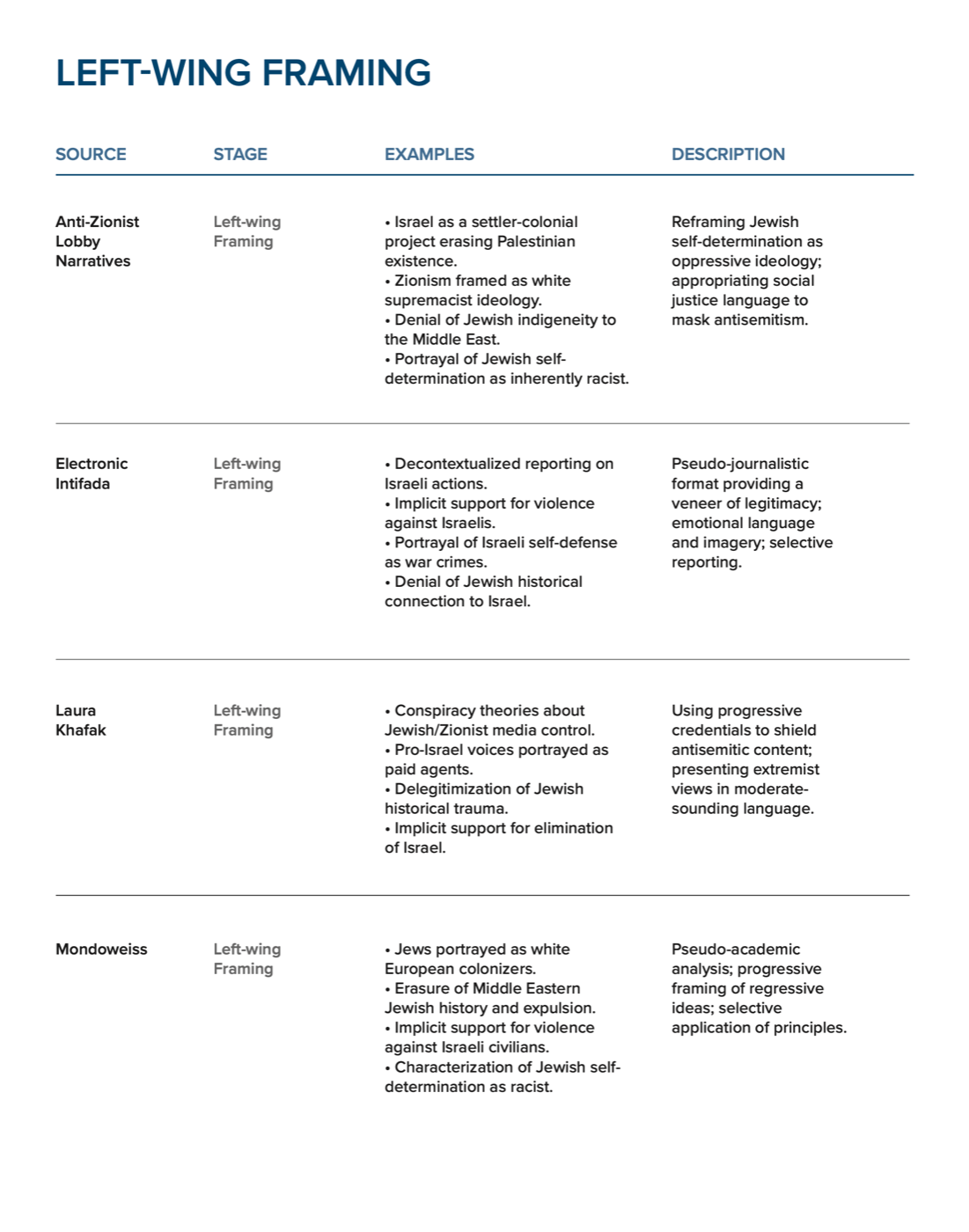
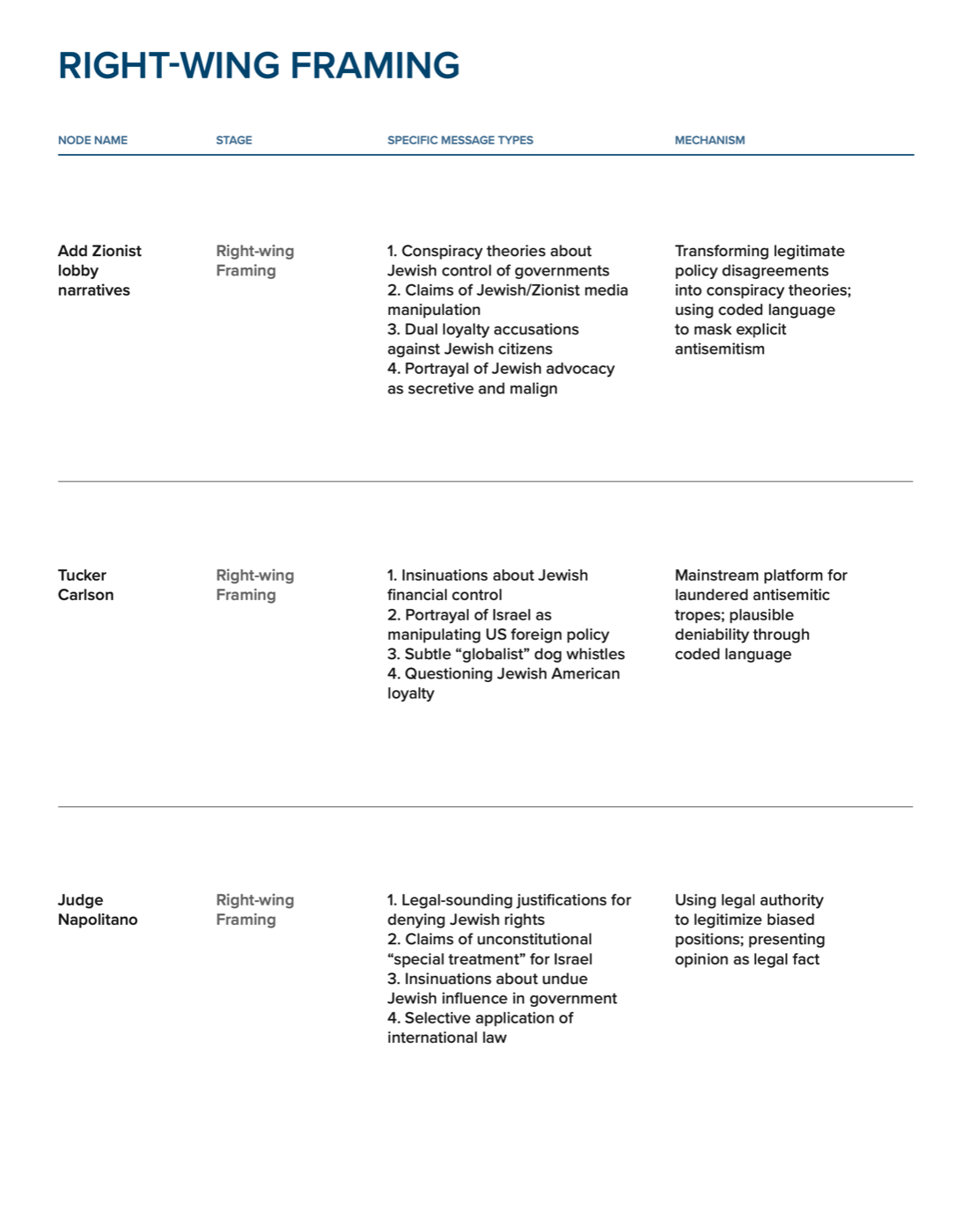
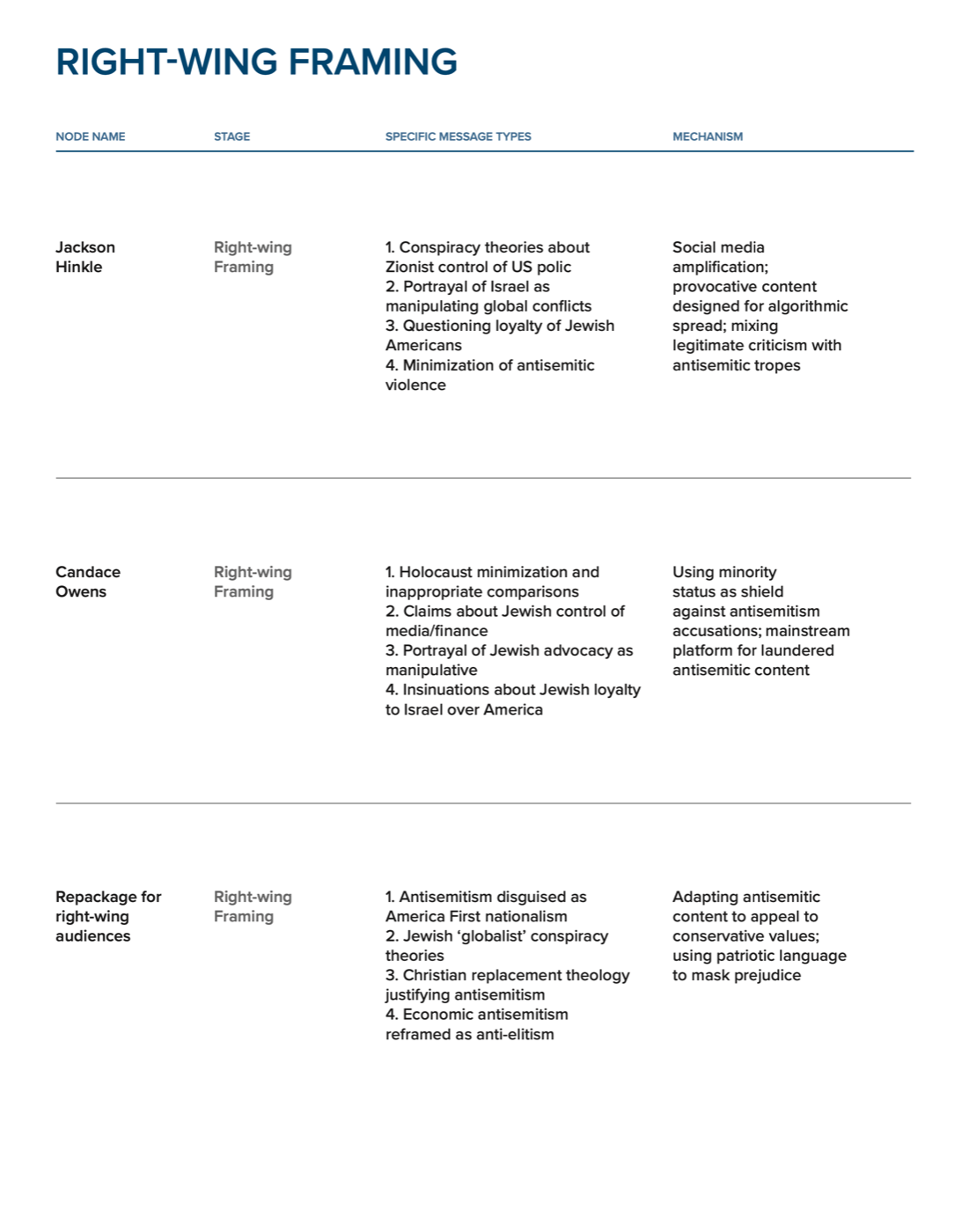
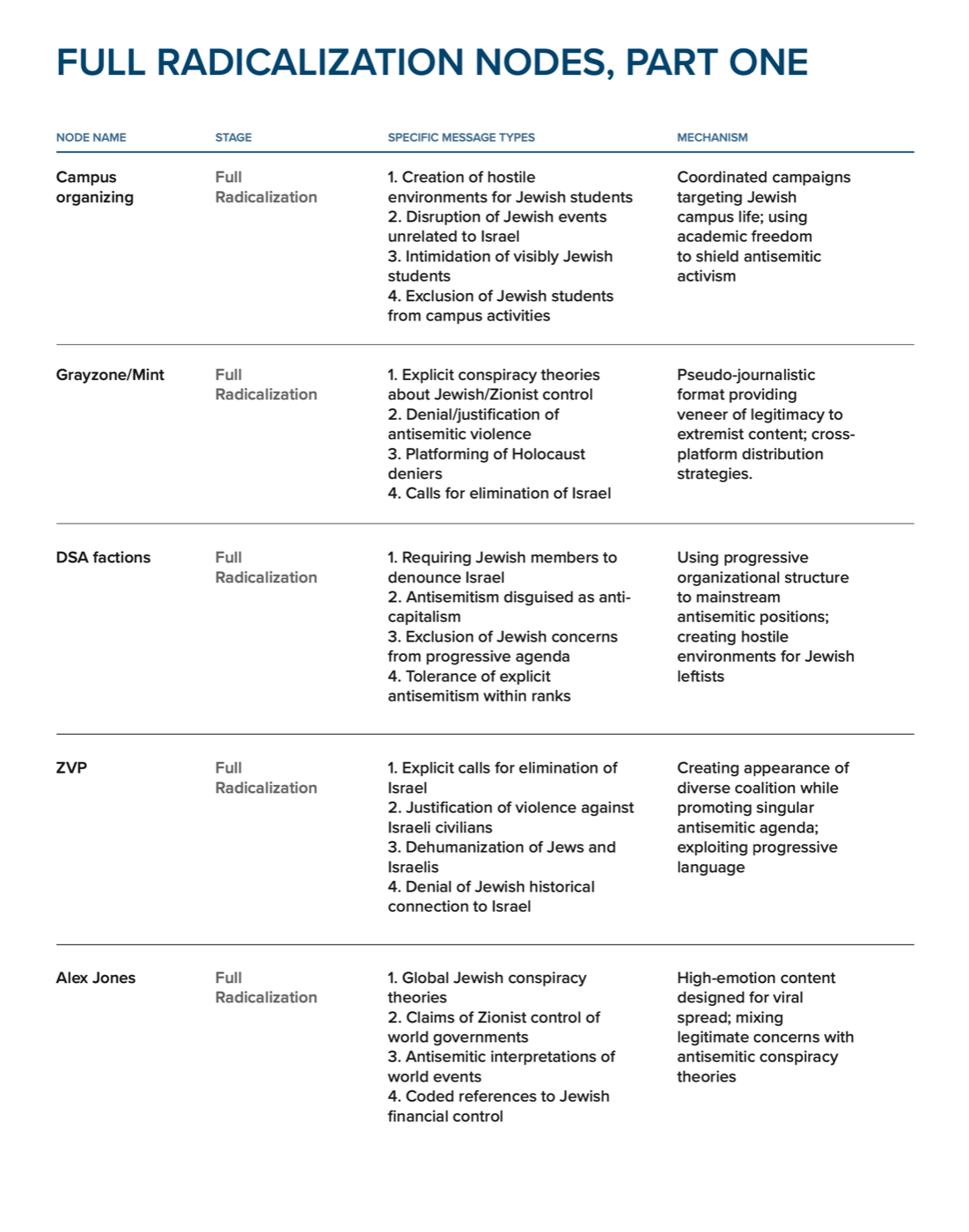
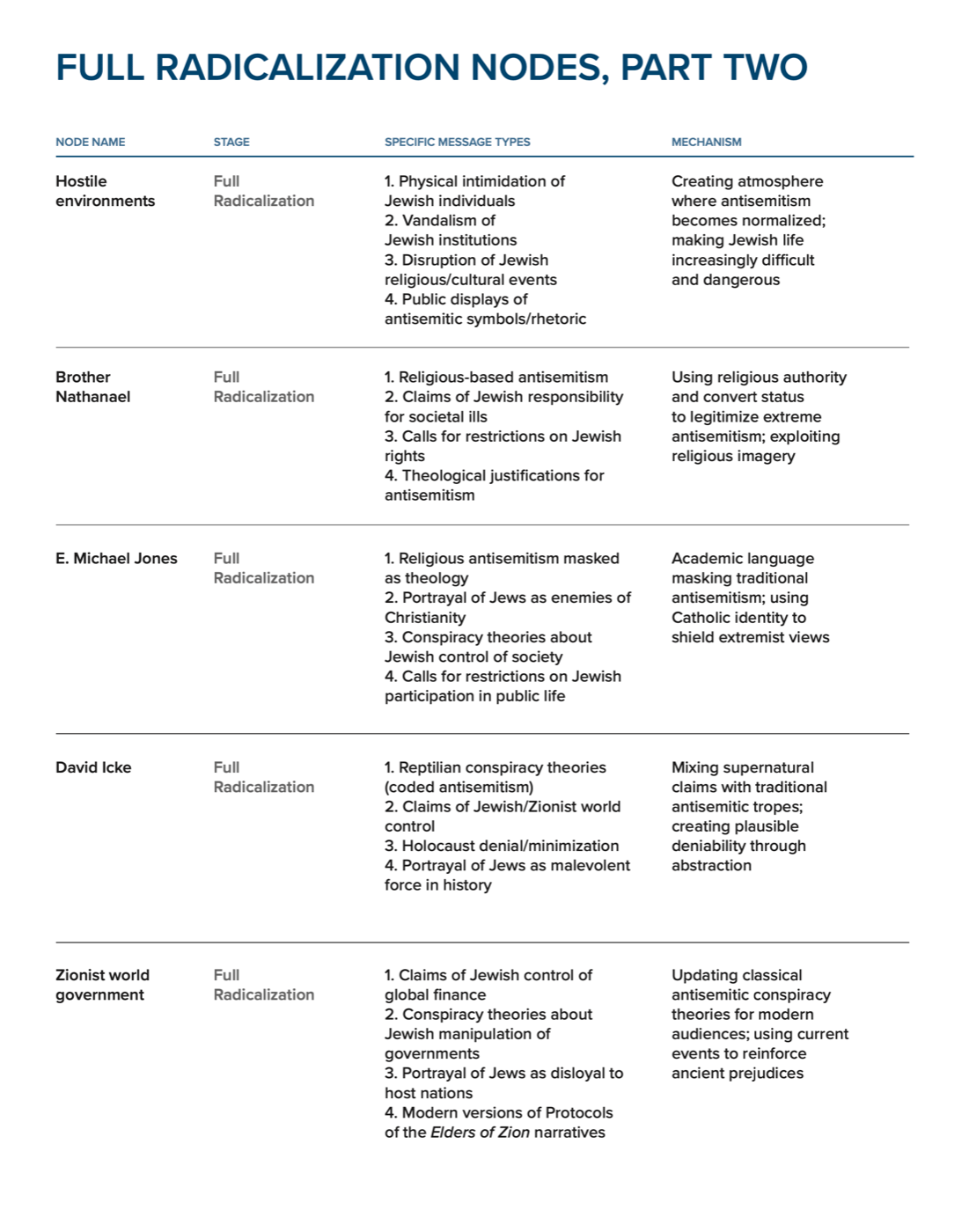
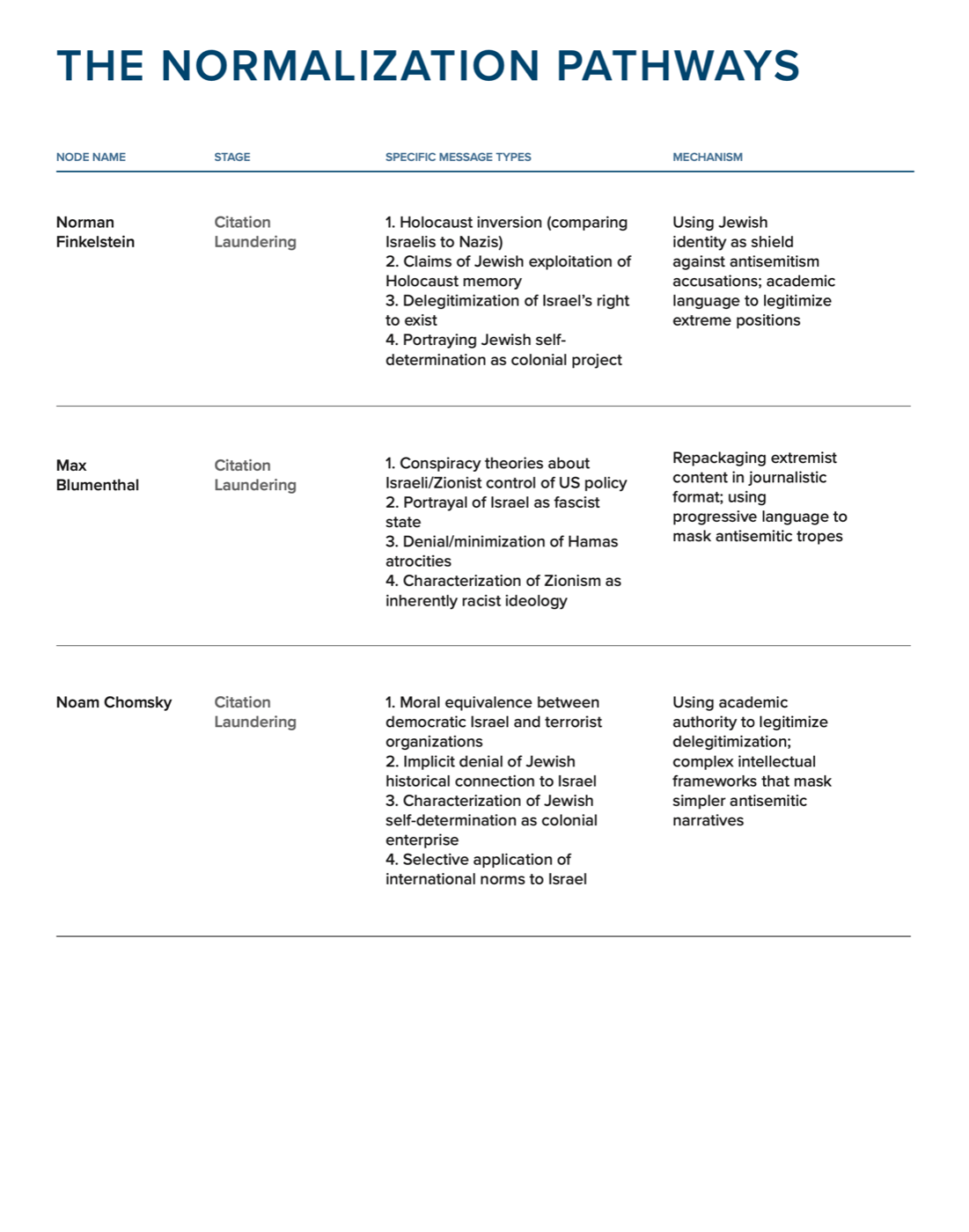
The Influence Map
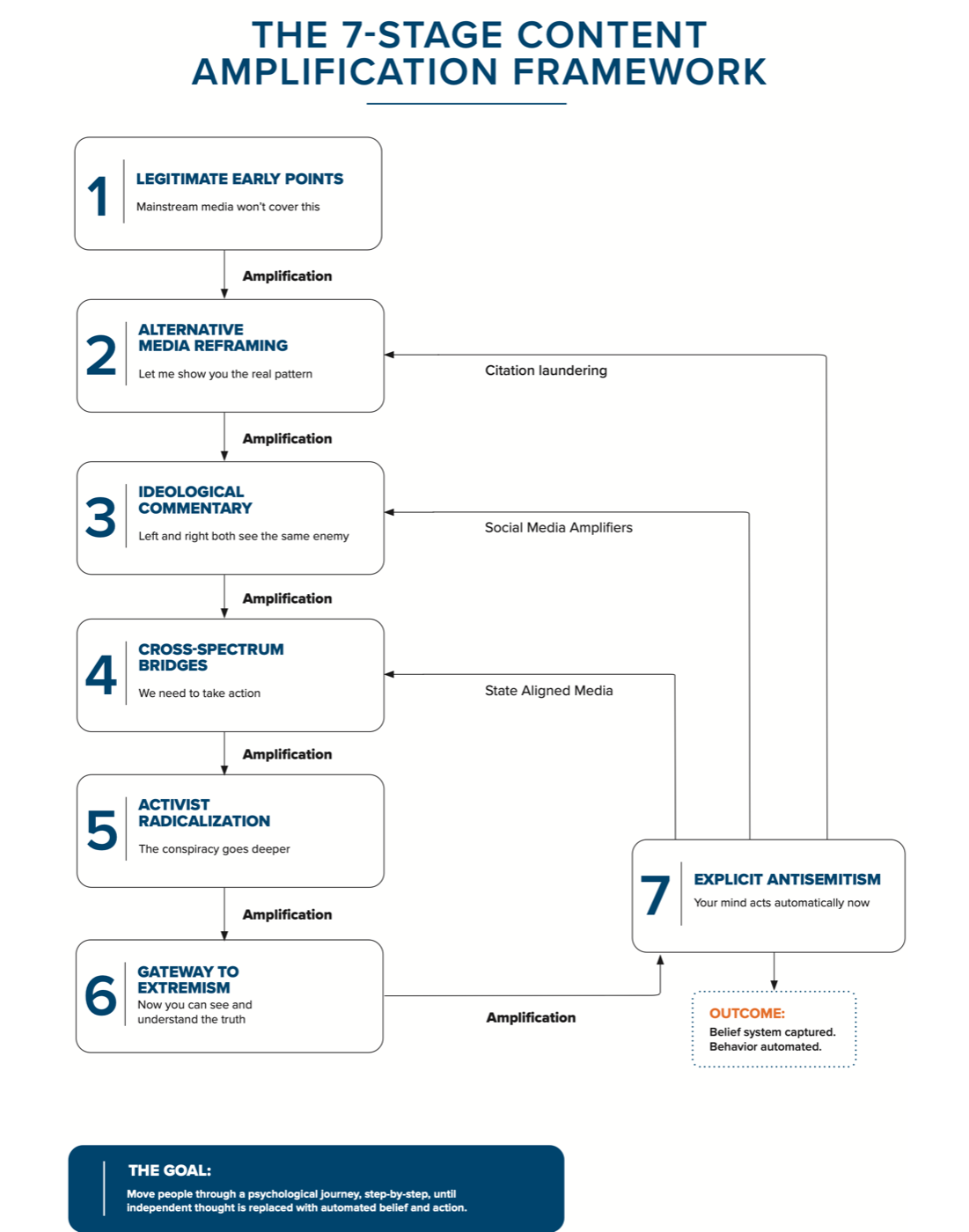
The rest of this section is available with a free unlock.
A Note on Sources and Named Individuals
How This Report Treats Evidence and the People It Names
Timeline
Three Decades of Iranian Influence Operations, 1996–2026
The rest of this section is available with a free unlock.
Selected Bibliography
Supplemental Reading
Read the full report
Enter your details to unlock every chapter of The War for Western Minds. It is free, and you can unsubscribe at any time.
Notes
- Iran's asymmetric defense strategy and use of disinformation as power projection. Alexander Donlon, "The Pacing Threat of Iran's Influence Operations," Middle East Policy Council, December 8, 2023, https://mepc.org/commentaries/the-pacing-threat-of-irans-influence-operations/; Sonja Swanbeck, "How to Understand Iranian Information Operations," Lawfare, February 19, 2021, https://www.lawfaremedia.org/article/how-understand-iranian-information-operations. ↩
- On the concept of soft war (jang-e narm) in Iranian state doctrine. See Monroe Price, “Iran and the Soft War,” International Journal of Communication 6 (2012): 2397–2415, https://ijoc.org/index.php/ijoc/article/view/1654/799; Emily L. Blout, “Soft War: Myth, Nationalism, and Media in Iran,” The Communication Review 20, no. 3 (2017): 212–24, https://doi.org/10.1080/10714421.2017.1346976; Rachel Kantz Feder, “‘New Horizons’ in Iranian Cultural Diplomacy: Nader Talebzadeh, Alexander Dugin, and Iran’s Soft War” (paper presented at the 47th Annual Conference of the Middle East & Islamic Studies Association of Israel, Open University of Israel, Ra’anana, Israel, May 8, 2024); Rachel Kantz Feder, “Cultural Diplomacy in the Struggle against the United States: ‘New Horizons’ in Iran’s Soft War” (paper presented at the Iran: 45 Years of Revolution: Challenges and Achievements Conference, Alliance Center for Iranian Studies, Tel Aviv University, Tel Aviv, Israel, February 7, 2024); and Rachel Kantz Feder, “‘New Horizons’ in Iranian Anti-Americanism and Antisemitism” (paper presented at the 21st Century Antisemitism Conference, London Centre for the Study of Contemporary Antisemitism, London, United Kingdom, September 11–13, 2022), https://londonantisemitism.com/conference-21st-century-antisemitism/. ↩
- Iran uses disinformation as power projection without provoking direct escalation. Swanbeck, “How to Understand Iranian Information Operations.” ↩
- Iran seeks to sow distrust in the U.S. political system and undermine democratic processes. Kevin Collier, "Iran's History of Elaborate Election Interference Efforts, before the Trump Campaign Hack," NBC News, October 1, 2024, https://www.nbcnews.com/tech/security/irans-history-elaborate-election-interference-efforts-trump-campaign-h-rcna171312; Microsoft Threat Analysis Center, "Iran Steps into US Election 2024 with Cyber-Enabled Influence Operations," August 9, 2024, https://cdn-dynmedia-1.microsoft.com/is/content/microsoftcorp/microsoft/final/en-us/microsoft-brand/documents/5bc57431-a7a9-49ad-944d-b93b7d35d0fc.pdf. ↩
- Swanbeck, "How to Understand Iranian Information Operations"; Collier, "Iran's History of Elaborate Election Interference Efforts"; Microsoft Threat Analysis Center, "Iran Steps into US Election 2024." ↩
- These techniques are not Iranian innovations. Soviet and later Russian intelligence services developed and field tested the strategy of exploiting strategic fracture points — extant divisions within a target society — decades before Iran adapted it. The tactical appropriation of anti-imperial and anti-colonial grievances used to court formerly colonized peoples and minorities in the West has a still longer lineage: Nazi propagandists sought to turn resentment of British and French colonial rule to Germany's advantage, cultivating collaborators and sympathetic movements abroad while also exploiting American racial discrimination in propaganda directed at Black U.S. military personnel. See Calder Walton, "What's Old Is New Again: Cold War Lessons for Countering Disinformation," Texas National Security Review 5, no. 4 (Fall 2022): 49–72, https://doi.org/10.26153/tsw/43940; Meredith L. Roman, Opposing Jim Crow: African Americans and the Soviet Indictment of U.S. Racism, 1928–1937 (Lincoln: University of Nebraska Press, 2012); Jeffrey Herf, Nazi Propaganda for the Arab World (New Haven, CT: Yale University Press, 2009), esp. 36–56. ↩
- The repackaging of antisemitism to suit the sensibilities of each era is itself a recurring feature of its history. The coining of the term “antisemitism” was driven by precisely these considerations: Wilhelm Marr sought to modernize Jew-hatred into something less superstitious and anachronistic, more congruent with the Enlightenment values of nineteenth-century European civilization. In similar fashion, David Duke set aside the Klan robe and hood for public appearances in favor of a suit and tie. In every generation, antisemitism must be made palatable and congruent with the times. ↩
- Dugin's sanctions designations and promotion by Russian state media. Dugin is designated on the U.S. Specially Designated Nationals (SDN) list and sanctioned by the EU and UK. He is promoted extensively by RT International (formerly Russia Today). Russia and Iran maintain formal agreements between their state media agencies. See "Russia's TASS Offers Condolences to Iranian Media, Citizens amid Israeli Strikes," Tehran Times, June 19, 2025, https://www.tehrantimes.com/news/514635/Russia-s-TASS-offers-condolences-to-Iranian-media-citizens. See also U.S. Department of the Treasury, Office of Foreign Assets Control, "Aleksandr Dugin," Specially Designated Nationals and Blocked Persons List (SDN), accessed August 18, 2026, https://sanctionssearch.ofac.treas.gov/Details.aspx?id=17760; European Union, "Aleksandr Dugin," EU Sanctions Tracker, accessed August 18, 2026, https://data.europa.eu/apps/eusanctionstracker/subjects/144495; UK Office of Financial Sanctions Implementation, "Aleksandr Dugin," UK Sanctions List, accessed August 18, 2026, https://search-uk-sanctions-list.service.gov.uk/?searchValue=Aleksandr%20Dugin. ↩
- In his influential 1997 treatise Foundations of Geopolitics, Aleksandr Dugin advised that Russia “introduce geopolitical disorder into internal American activity, encouraging all kinds of separatism and ethnic, social and racial conflicts, actively supporting all dissident movements—extremist, racist, and sectarian groups, thus destabilizing internal political processes in the U.S.,” adding that it “would also make sense simultaneously to support isolationist tendencies in American politics.” John B. Dunlop, “Aleksandr Dugin’s Foundations of Geopolitics,” Demokratizatsiya 12, no. 1 (2004): 48, quoting and translating Aleksandr Dugin, Osnovy geopolitiki: Geopoliticheskoe budushchee Rossii (Moscow: Arktogeya, 1997), 367. ↩
- Dugin's The Fourth Political Theory and anti-liberal geopolitical framework. Aleksandr Dugin, The Fourth Political Theory (London: Arktos Media, 2012). On Dugin's views and their relationship to Middle Eastern politics, see Dmitry Shlapentokh, "Alexander Dugin's Views on the Middle East," Space and Polity 12, no. 2 (2008): 251–268, https://doi.org/10.1080/13562570802173448; Kantz Feder, "New Horizons in Iranian Cultural Diplomacy"; Kantz Feder, "Cultural Diplomacy in the Struggle against the United States"; and Kantz Feder, "New Horizons in Iranian Anti-Americanism and Antisemitism." ↩
- Narrative intelligence (NARINT) definition and role in national security. Joe Stradinger, "Narrative Intelligence: Detecting Chinese and Russian Information Operations to Disrupt NATO Unity," Foreign Policy Research Institute, November 5, 2024, https://www.fpri.org/article/2024/11/intelligence-china-russia-information-operations-against-nato/; Kandace Miller, "The Power of OSINT, Narrative Intelligence, and Cybersecurity in a Post-Truth World," Blackbird.AI, accessed August 17, 2026, https://blackbird.ai/blog/osint-public-trust/. ↩
- USIC tracking of narrative intelligence / Foreign Malign Influence as a core national security priority. The United States Intelligence Community continues to track Foreign Malign Influence (FMI) as a core national security concern in 2026. While specific interagency task forces have faced recent restructuring — the Foreign Malign Influence Center's own website has been archived and is no longer updated — the mission has shifted toward integrated, AI-driven monitoring and asymmetric response strategies. Office of the Director of National Intelligence, "Foreign Malign Influence Center," accessed August 17, 2026, https://archive.dni.gov/index.php/fmic; Office of the Director of National Intelligence, "How We Work," Foreign Malign Influence Center, accessed August 17, 2026, https://archive.dni.gov/index.php/fmic/how-we-work; Office of the Director of National Intelligence, Artificial Intelligence Ethics Framework for the Intelligence Community, accessed August 17, 2026, https://www.dni.gov/files/ODNI/documents/AI_Ethics_Framework_for_the_Intelligence_Community_10.pdf. ↩
- Eschatological and apocalyptic symbolism in the digital information ecosystem surrounding the Iran-Israel-U.S. conflict. Conspiracy theorists and influencers including Dugin frequently reference biblical texts — Ezekiel 38 and Zechariah 12 — to frame the conflict as a final apocalyptic battle between a Eurasian-led coalition and the forces controlling Jerusalem. ↩
- Farrakhan's World Friendship Tour (1996). Maize Woodford, "A Chronology: Farrakhan's 'World Friendship Tour' to Africa and the Middle East: January–February 1996," Black Scholar 26, no. 3–4 (1996): 35–40; George Michael, "Louis Farrakhan's Outreach to Muslims in Africa and the Middle East," Journal of Social, Political, and Economic Studies 40, nos. 1–2 (Spring/Summer 2015): 77–93. ↩
- Louis Farrakhan (b. 1933) has led the Nation of Islam, a Black nationalist religious movement founded in 1930, since the late 1970s. Over several decades, he delivered numerous addresses characterizing Jewish Americans as exercising disproportionate control over finance, media, and government, rhetoric widely documented and condemned as antisemitic. The Nation of Islam combines Black separatist theology with a long record of antisemitic and anti-Zionist messaging, and its newspaper, The Final Call, remains its principal organ. See also: Anti-Defamation League, "Farrakhan: In His Own Words," January 17, 2019, updated August 2, 2023, https://www.adl.org/resources/backgrounder/farrakhan-his-own-words. ↩
- The Tehran Declaration (February 2001). United Nations, Report of the Asian Preparatory Meeting for the World Conference against Racism, Racial Discrimination, Xenophobia and Related Intolerance, Tehran, 19–21 February 2001: Note by the Secretary-General, A/CONF.189/PC.2/9 (Geneva: UN, April 10, 2001), https://digitallibrary.un.org/record/439865. ↩
- U.S. and Israeli withdrawal from Durban. United Nations, Report of the Asian Preparatory Meeting, A/CONF.189/PC.2/9; the withdrawal context is established in that report and in contemporaneous news coverage of the Durban conference. See Tom Lantos, "The Durban Debacle: An Insider's View of the World Racism Conference at Durban," The Fletcher Forum of World Affairs 26, no. 1 (Winter/Spring 2002): 31–52, https://ngo-monitor.org/wp-content/uploads/2021/12/Lantos-Durban-PDF.pdf ↩
- Ajamu Baraka's involvement in the Durban preparatory process. The People's Forum, "Ajamu Baraka," accessed August 14, 2026, https://peoplesforum.org/instructor/ajamu-baraka/. ↩
- The "4,000 Jews" claim and Iran's amplification of it. Linda Grant, "The Hate That Will Not Die," The Guardian, December 18, 2001, https://www.theguardian.com/world/2001/dec/18/september11.israel. ↩
- Dennis King, Lyndon LaRouche and the New American Fascism (New York: Doubleday, 1989) ↩
- Nizkor Project, “Uncommon Ground: Another Black-White Extremist Link, NOI and Lyndon LaRouche,” accessed July 26, 2026, https://www.nizkor.org/uncommon-ground-another-black-white-extremist-link-noi-and-lyndon-larouche/. ↩
- Lyndon H. LaRouche Jr., “LaRouche Urges: Calm Down! The Enemy Is Right Here in the U.S.A.,” interview by John Sigerson, September 18, 2001, Schiller Institute, https://archive.schillerinstitute.com/radio_lar_sep_2001/sdi_lar_jws_9_18_01.html. ↩
- Mahmoud Alinejad, “Political Islam in Iran and the Emergence of a Religious Public Sphere: The Impact of September 11,” in Media, War, and Terrorism: Responses from the Middle East and Asia, ed. Peter van der Veer and Shoma Munshi (London: Routledge, 2004), 105–106. ↩
- George Michael, "Deciphering Ahmadinejad's Holocaust Revisionism," Middle East Quarterly 14, no. 3 (Summer 2007): 11–18, https://www.meforum.org/middle-east-quarterly/deciphering-ahmadinejads-holocaust-revisionism. ↩
- Nader Talebzadeh: identity, role, and death. “Nader Talebzadeh, filmmaker and TV producer of revolutionary programs, dies at 69,” Tehran Times, April 30, 2022, https://www.tehrantimes.com/news/472237/Nader-Talebzadeh-filmmaker-and-TV-producer-of-revolutionary. ↩
- "Biography, Eulogies, and Lingering Questions," The Mike Piper Report, accessed August 14, 2026, https://www.mikepiperreport.com/Biography/BiographyIndex.html. See also Kantz Feder, "New Horizons in Iranian Cultural Diplomacy." ↩
- Michael, "Deciphering Ahmadinejad's Holocaust Revisionism"; George Michael, "Michael Collins Piper: An American Far Right Emissary to the Islamic World," Totalitarian Movements and Political Religions 9, no. 1 (2008): 61–78, https://doi.org/10.1080/14690760701856390. ↩
- Michael Collins Piper, "Iranian President Resists NWO," American Free Press, October 9, 2006, https://www.mikepiperreport.com/Articles_Archive/AmericanFreePress/AFP2006_07-12/Michael_Collins_Piper_AFP20061009_Iranian_President_Resists_NWO.html. ↩
- Michael, "Deciphering Ahmadinejad's Holocaust Revisionism," 14–15; Kevin Alfred Strom, "In the Cause of Peace and Freedom: An Open Letter to Ahmadinejad," American Dissident Voices, National Vanguard, June 25, 2006, https://nationalvanguard.org/2010/09/in-the-cause-of-peace-and-freedom-an-open-letter-to-ahmadinejad/. ↩
- Scott Peterson, "In hit Iranian TV drama, Holocaust no 'myth,'" The Christian Science Monitor, November 27, 2007, https://www.csmonitor.com/2007/1127/p01s06-wome.html. ↩
- On the Soviet and Nazi lineage of this technique. See note 6. ↩
- Talebzadeh quotes on The Messiah, Jesus, the Spirit of God. Bei Chatlai Beita, "Iranian Filmmaker's Islamic Jesus to Make TV Debut," The Christian Post, January 17, 2008, https://www.christianpost.com/news/iranian-filmmaker-s-islamic-jesus-to-make-tv-debut.html. ↩
- CODEPINK is a U.S. anti-war advocacy organization founded in 2002 by Medea Benjamin and Jodie Evans, known for its activism against U.S. military intervention and, in later years, for its participation in delegations to Iran and its prominence in anti-Israel campaigning. See "What Is CODEPINK," CODEPINK: Women for Peace, accessed August 14, 2026, https://www.codepink.org/about. As of the writing of this report, the group is under federal scrutiny on two fronts: members of Congress have called for a Department of Justice investigation into potential violations of the Foreign Agents Registration Act (FARA) and possible material support to designated foreign terrorist organizations, and the Treasury Department's Office of Foreign Assets Control (OFAC) has opened an inquiry into the group's March 2026 trip to Cuba. See Tom Cotton, letter to Attorney General Pam Bondi, November 7, 2025, https://www.cotton.senate.gov/news/press-releases/cotton-to-bondi-investigate-code-pink; Asra Nomani, "CodePink's Medea Benjamin confirms getting 'serious' Treasury Department query over Cuba trip," Fox News, May 29, 2026, https://www.foxnews.com/politics/codepinks-medea-benjamin-confirms-getting-serious-treasury-department-query-cuba-trip. ↩
- Linda Milazzo, "US Citizen Diplomats Arrive in Iran, Invited by Ahmadinejad," Common Dreams, November 23, 2008, https://www.commondreams.org/views/2008/11/23/us-citizen-diplomats-arrive-iran-invited-ahmadinejad. See also: Reza Fiyouzat, "Code Pink in Iran," Dissident Voice, November 28, 2008, https://dissidentvoice.org/2008/11/code-pink-in-iran/, for Medea Benjamin's 2008 Iran trip; Narges Bajoghli, "Debating the Iran-Iraq War on Film," MERIP, July 12, 2014, https://www.merip.org/2014/07/debating-the-iran-iraq-war-on-film/, for Habib Ahmadzadeh's Basij background. The Basij is a volunteer paramilitary militia, one of the five branches of the Islamic Revolutionary Guard Corps, operating under the direct authority of Iran's Supreme Leader and serving as a principal instrument of domestic security, social control, and the suppression of dissent. Hossein Aryan, "Iran's Basij Force -- The Mainstay of Domestic Security," Radio Free Europe/Radio Liberty, December 7, 2008, https://www.rferl.org/a/Irans_Basij_Force_Mainstay_Of_Domestic_Security/1357081.html. Kantz Feder, "Cultural Diplomacy in the Struggle against the United States: 'New Horizons' in Iran's Soft War." ↩
- U.S. Department of the Treasury, Office of Foreign Assets Control, "Treasury Sanctions Iranian Organizations and Individuals Supporting Intelligence and Cyber Targeting of U.S. Persons," February 13, 2019, https://home.treasury.gov/news/press-releases/sm611. ↩
- Talebzadeh, Ammar Festival, Oliver Stone and Sean Stone. Kantz Feder, "New Horizons in Iranian Cultural Diplomacy: Nader Talebzadeh, Alexander Dugin, and Iran's Soft War"; Mehr News Agency, "Nader Talebzadeh's Live Conversation with Oliver Stone on Channel 4" [رﺎﮭﭼ ﮫﮑﺒﺷ رد نﻮﺘﺳا رﻮﯿﻟا ﺎﺑ هدازﺐﻟﺎط ردﺎﻧ هﺪﻧز یﻮﮕﺘﻔﮔ], April 24, 2018, https://www.mehrnews.com/news/4279485/رﺎﮭﭼ-ﮫﮑﺒﺷ-رد-نﻮﺘﺳا-رﻮﯿﻟا-ﺎﺑ-هداز-ﺐﻟﺎط-ردﺎﻧ-هﺪﻧز-یﻮﮕﺘﻔﮔ; Paideuma, "Sean Stone & Alexander Dugin," February 10, 2023, https://paideuma.tv/en/video/sean-stone-alexander-dugin. ↩
- Hollywoodism conference participants: Third Position Party, LaRouche, far-right. On Third Position fascism, Matthew N. Lyons, "Two Ways of Looking at Fascism," Socialism and Democracy 22, no. 2 (2008): 121–156. On LaRouche's trajectory, King, Lyndon LaRouche and the New American Fascism. ↩
- Thomas Erdbrink, “Stung by ‘Argo,’ Iran Backs Conference Denouncing ‘Hollywoodism,’” New York Times, February 18, 2013, https://www.nytimes.com/2013/02/19/world/middleeast/stung-by-argo-iran-backs-conference-denouncing-hollywoodism.html. See also Alireza Doostdar, “Hollywood Cosmopolitanisms and the Occult Resonance of Cinema,” Comparative Islamic Studies 13, nos. 1–2 (2017): 121–49, esp. 130–35, https://doi.org/10.1558/cis.32526 ↩
- Hollywoodism: Holocaust myth panels, Roger Garaudy film screenings. Joshua Keating, "Mike Gravel on Movies, Sanctions, and What We Can Learn from Iran," Foreign Policy, February 13, 2013, https://foreignpolicy.com/2013/02/22/mike-gravel-on-movies-sanctions-and-what-we-can-learn-from-iran/; Iranian Students' News Agency (ISNA), "Sean Stone Returns to Iran / Announcing Details of the Third Hollywoodism Conference" [Shān Estūn Dobārah bā Irān Mi-Āyad], January 15, 2013. ↩
- Kevin Barrett / Truth Jihad Radio description. Kevin Barrett, "Farrakhan Draws 4,000 for 9/11 Truth," American Free Press, March 10, 2017, https://americanfreepress.net/farrakhan-draws-4000-for-911-truth/; Kevin Barrett, "About Kevin Barrett," Truth Jihad, accessed July 27, 2026, https://truthjihad.com/about/. See also Anti-Defamation League, "Iran 'Hollywoodism' Conference Partners with U.S. & International Anti-Semites, Conspiracy Theorists," February 5, 2013, archived July 5, 2019, https://web.archive.org/web/20190705150722/https://www.adl.org/blog/iran-hollywoodism-conference-partners-with-us-international-anti-semites-conspiracy-theorists; Mark Weber, "Another Productive Visit to Iran: Tehran Conference Critically Examines 'Hollywoodism,'" Institute for Historical Review, February– March 2013, https://ihr.org/other/iranvisit_feb2013-html. ↩
- Philip Giraldi and Alison Weir; Giraldi's 9/11 allegations. Kantz Feder, "'New Horizons' in Iranian Anti-Americanism and Antisemitism." On Giraldi's specific claims about Israel and 9/11, see Philip Giraldi, "Israel's Role In 9/11," Freepress.org (Columbus Free Press), September 11, 2019, https://freepress.org/article/israel-s-role-911. See also London Centre for the Study of Contemporary Antisemitism, "Rachel Kantz Feder, '"New Horizons" in Iranian Anti-Americanism and Antisemitism,'" YouTube video, January 11, 2023, https://www.youtube.com/watch?v=LTW8ilJ3efs&t=98s. Presentation given at the LCSCA conference, September 2022. ↩
- Art Olivier's disclosure that conference organizers sponsored his trip. Ramin Mostaghim, "Tehran film conference denounces 'cultural assault' of Hollywood," Los Angeles Times, February 5, 2013, https://www.latimes.com/world/la-xpm-2013-feb-05-la-fg-wn-tehran-conference-denounces-cultural-assault-of-hollywood-20130205-story.html. ↩
- Anti-Defamation League, "E. Michael Jones," July 13, 2023, https://go.adl.org/resources/backgrounder/e-michael-jones. The profile documents Jones's characterization of Judaism as possessing a "particularly malignant spirit" and his description of abortion, same-sex marriage, and pornography as "Jewish sacraments." See also Mark Weber, "Another Productive Visit to Iran: Tehran Conference Critically Examines 'Hollywoodism,'" Institute for Historical Review, February–March 2013, https://ihr.org/other/iranvisit_feb2013-html; E. Michael Jones, "E. Michael Jones Visits Iran: The Hijab Protest Reality," Culture Wars, June 7, 2023, https://culturewars.com/videos/e-michael-jones-visits-iran-the-hijab-protest-reality; Kamal Gasimov and Marlene Laruelle, "Eurasia and Eschatology: Dugin's Antiliberal Resonances in the Muslim World," Studies in East European Thought 78, nos. 1–2 (2026): 377–399, https://doi.org/10.1007/s11212-025-09810-1. ↩
- Candace Owens, "Candace Owens x E. Michael Jones," Candace, podcast, July 18, 2025, https://podcasts.apple.com/be/podcast/candace-owens-x-e-michael-jones/id1750591415?i=1000717998368. ↩
- Marzieh Hashemi: American-born convert, naturalized Iranian citizen, Press TV. "Iranian Reporter Tells The Other Side Of The Story," interview by Scott Simon, Weekend Edition Saturday, NPR, July 4, 2009, https://www.npr.org/2009/07/04/106268425/iranian-reporter-tells-the-other-side-of-the-story. ↩
- Cynthia McKinney as a regular Press TV interviewee on Marzieh Hashemi's shows. The River Mersey, "Cynthia McKinney: Face to Face 05-20-2011," YouTube video, May 21, 2011, https://www.youtube.com/watch?v=GFSmcYx8z-Y. ↩
- JET Staff, "Malcolm X's Grandson Arrested by FBI," JET, February 5, 2013, https://www.jetmag.com/news/malcolm-xs-grandson-arrested-by-fbi/; Kirsten West Savali, "Malcolm Shabazz, Malcolm X's Grandson, Releases Statement," NewsOne, March 18, 2013, https://newsone.com/2287421/malcolm-shabazz-arrested-statement. See also "Malcolm X's Grandson Reportedly Arrested, FBI Refuses to Provide Details," Atlanta Daily World, February 5, 2013, https://atlantadailyworld.com/2013/02/05/malcolm-x-s-grandson-reported-arrested-en-route-to-iran/; and Keith Nelson Jr., "Malcolm X's Grandson Releases Statement, Details Lengthy Police Investigation," AllHipHop, March 20, 2013, https://allhiphop.com/mobile/malcolm-xs-grandson-releases-statement-details-lengthy-police-investigation/. ↩
- Shabazz arrest story; his later appearance in a Press TV documentary. "Malcolm X's Grandson Reportedly Arrested, FBI Refuses to Provide Details," Atlanta Daily World, February 5, 2013. ↩
- Abdul Alim Musa / Sabiqun: founding of the Islamic Institute of Counter-Zionist American Psychological Warfare; 9/11 allegations. Anti-Defamation League, "Sabiqun and Anti-Semitism on Campus," November 14, 2011, https://www.adl.org/resources/backgrounder/sabiqun-and-anti-semitism-campus. ↩
- Abdul Alim Musa interview: American carceral methods modeled on "Zionist police in Palestine." "US Black Community: From Oppression under Capitalism to Liberation in Islam," interview by Setareh Sadeqi, Khamenei.ir, 2017, https://english.khamenei.ir/news/4508/US-black-community-From-oppression-under-capitalism-to-liberation. ↩
- New Horizon as IRGC recruitment platform; operational significance of the conferences. U.S. Department of the Treasury, Office of Foreign Assets Control, "Treasury Sanctions Iranian Organizations and Individuals Supporting Intelligence and Cyber Targeting of U.S. Persons," February 13, 2019. Speeches by Western attendees were repackaged into digital clips, shared by Iranian media outlets, and circulated by bot networks to create the appearance of global legitimacy. See also Lizzie Porter, "What Sanctions? An Iranian Conference in Beirut Just Happened," Atlantic Council (IranSource), October 24, 2019, https://www.atlanticcouncil.org/blogs/iransource/what-sanctions-an-iranian-conference-in-beirut-just-happened/. ↩
- FOIA Research, "New Horizon Conference," April 25, 2020, https://www.foiaresearch.net/event/new-horizon-conference. The report documents the participation of both self-described left-wing and far-right activists, identifies Savin among the participants in 2012, 2014, and 2019, and reproduces the organizations listed in New Horizon's "Friends" directory. See also Alexander Reid Ross, "The Anti-Semitism Fest Where Russian Spies, Code Pink, David Duke and the Nation of Islam Make Friends and Influence People," Haaretz, March 14, 2019, https://www.haaretz.com/world-news/.premium-russia-s-role-in-an-anti-semitism-fest-for-fascists-feminists-spies-and-neo-nazi-1.7003563. Erik Piccoli, "The Dugin Network: Multipolarity, Traditionalism, and Transnational Liaisons in the West," Studies in East European Thought 78, nos. 1–2 (2026): 335–354, https://doi.org/10.1007/s11212-025-09807-w. Piccoli identifies Leonid Savin as editor-in-chief of Geopolitika and head of administration for the International Eurasian Movement. "The Fourth Political Theory," accessed July 27, 2026, https://www.4pt.su/en. The site uses the slogan "beyond left and right but against the center." ↩
- Left Forum cross-participation by New Horizon regulars. Kantz Feder, "'New Horizons' in Iranian Anti-Americanism and Antisemitism." A cross-check of Left Forum programs confirms participation by Alison Weir, Philip Giraldi, Kevin Barrett, and Sander Hicks. See also London Centre for the Study of Contemporary Antisemitism, "Rachel Kantz Feder," YouTube video. ↩
- Panels from the 2014 conference. NGO Monitor, "NGO Activists, Including Stephen Sizer, Attend Antisemitic Conference in Iran," accessed August 14, 2026, https://ngo-monitor.org/reports/ngo_activists_including_stephen_sizer_attend_antisemitic_conference_in_iran/. ↩
- Caleb Maupin: World Workers' Party, RT contributor, Moscow conference with Dugin. New Horizons Conference website, archived April 28, 2020, http://web.archive.org/web/20200428234125/http://newhorizon.ir/friends/; on Maupin's red-brown populism, Chris Butters, "Signaling Left, Turning Right: The 'Radicals' Rebranding Populism," CPUSA, December 17, 2021, https://www.cpusa.org/article/signaling-left-turning-right-the-radicals-rebranding-populism/. See also NGO Monitor, "NGO Activists, Including Stephen Sizer, Attend Antisemitic Conference in Iran." ↩
- Iranian political and religious figures at the 2014 New Horizon Conference. Iranian participants included Vahid Jalili (Director of the Cultural Front for the Revolution), Hujjat al-Islam Alireza Panahian, Saeed Jalili, Mohammad-Javad Larijani, and Fuoad Izadi. See "New Horizon Conference," FOIA Research, accessed August 15, 2026, https://www.foiaresearch.net/event/new-horizon-conference. ↩
- Conference participants writing for Iranian outlets; collaboration in alternative media. Kantz Feder, "'New Horizons' in Iranian Anti-Americanism and Antisemitism." See also London Centre for the Study of Contemporary Antisemitism, "Rachel Kantz Feder," YouTube video. ↩
- Nick Allen, "Iran Invites Families of Black Men Shot by Police to a Tehran Anti-Discrimination Conference," The Telegraph, September 27, 2015, https://www.telegraph.co.uk/news/worldnews/middleeast/iran/11895197/Iran-invites-families-of-black-men-shot-by-police-to-a-Tehran-anti-discrimination-conference.html. See also "Iran Invites Black Americans to Discrimination Conference," Times of Israel, September 28, 2015, https://www.timesofisrael.com/iran-invites-black-americans-to-discrimination-conference/; "Iranian Conference Focuses on 'Police Racism' in the US," The New Arab, October 29, 2015, https://www.newarab.com/news/iranian-conference-focuses-police-racism-us (quoting Talebzadeh's remarks about inviting "30 anti-Zionist black leaders from America"). ↩
- 2015 New Horizon police-brutality conference participants; Cecile Johnson at Dugin's 2023 World Online Conference on Multipolarity. Nisa Islam Muhammad, "Nation of Islam Delegation Attends International Conference," The Final Call, November 11, 2015, http://www.finalcall.com/artman/publish/National_News_2/article_102703.shtml; Cecile Johnson, "My Speech at the Multipolarity Conference," African Development Plan, April 29, 2023, https://africandevelopmentplan.org/f/my-speech-at-the-multipolarity-conference. ↩
- Caleb Maupin, "The Struggle Against Racism, Zionism, and Imperialism within U.S. Borders," New Horizon Conference: On the Brink, Tehran, Iran, October 29, 2015, video, racism.org, https://racism.org/articles/worldwide/georegions/149-the-americas/168-united-states-of-america/205-daeus-descendants/201-on-the-brink-02/1861-the-struggle-against; Declan Hayes, "Israel: The Harvard University of American Police Brutality," New Horizon Conference: On the Brink, Tehran, Iran, October 28, 2015, video, racism.org, https://racism.org/articles/worldwide/georegions/149-the-americas/168-united-states-of-america/205-daeus-descendants/201-on-the-brink-02/1859-israel-the-harvard. ↩
- The accusation that would crystallize as the Deadly Exchange campaign had a documented evidentiary and rhetorical lineage predating it by several years. In 2011, the journalist Max Blumenthal described what he termed the "Israelification" of American domestic security, tracing the transfer of surveillance and crowd-control techniques from Israeli security forces to U.S. law enforcement. Max Blumenthal, "From Occupation to 'Occupy': The Israelification of American Domestic Security," Mondoweiss, December 2, 2011, https://mondoweiss.net/2011/12/from-occupation-to-occupy-the-israelification-of-american-domestic-decurity/. In 2014, Rania Khalek, writing in The Electronic Intifada, drew connections between Israeli military training and the policing of protests in Ferguson, Missouri. Rania Khalek, "Israel-Trained Police 'Occupy' Missouri after Killing of Black Youth," The Electronic Intifada, August 15, 2014, https://electronicintifada.net/blogs/rania-khalek/israel-trained-police-occupy-missouri-after-killing-black-youth. The International Jewish Anti-Zionist Network advanced parallel critiques of U.S.-Israel security cooperation in the same period. "Apartheid Israel and US Police," International Jewish Anti-Zionist Network, July 23, 2020, https://www.ijan.org/2020/07/23/apartheid-israel-and-us-police/. When Jewish Voice for Peace launched its Deadly Exchange campaign — beginning in 2017 and formalized in a 2018 report produced with Researching the American Israeli Alliance — it consolidated these earlier threads into a coordinated advocacy effort centered on the Anti-Defamation League's facilitation of such exchanges. "Deadly Exchange Report Reveals Extent of Massive Training Programs between U.S. Law Enforcement and Israeli Police, Military and the Shin Bet," Jewish Voice for Peace, September 12, 2018, https://www.jewishvoiceforpeace.org/2018/09/12/deadlyexchangereport/. The framework has continued to find new anchors; outlets such as Quds News have extended it to allegations of Israeli training ties to U.S. immigration enforcement. "After Killing Woman and Blocking Doctor from Helping Her in Minneapolis: Are ICE Agents Trained by Israel?," Quds News Network, January 8, 2026, https://qudsnen.co/post?id=67023&slug=after-killing-woman-and-blocking-doctor-from-helping-her-in-minneapolis-are-ice-agents-trained-by-israel ↩
- Origins of the Deadly Exchange framing in early-2010s activist critiques. Angela Davis has noted that since 2010–2011 she and others had discussed linking Israel to police brutality and solidarity with Palestine. London Centre for the Study of Contemporary Antisemitism, “Rachel Kantz Feder.” ↩
- Iran's institutionalization and internationalization of the Deadly Exchange. Kantz Feder, "'New Horizons' in Iranian Anti-Americanism and Antisemitism." Iran did not invent the trope but institutionalized and internationalized it as a strategy to delegitimize Israel and American Jews through race-based moral critique. See also David Michael Swindle, "Iran, Russia Push Disinformation to Spread Antisemitism, Undermine the West," The Algemeiner, March 11, 2026, https://www.algemeiner.com/2026/03/11/iran-russia-push-disinformation-spread-antisemitism-undermine-west/. ↩
- 2019 Beirut conference themes. "International New Horizon Conference Kicks Off in Lebanon," Press TV, September 23, 2019, https://www.presstv.ir/Detail/2019/09/23/606930/New-Horizon-Conference-Beirut-Nader-Talebzadeh. ↩
- Mark Sedgwick, "Aleksandr Dugin's Traditionalist Roots," Studies in East European Thought 78, nos. 1–2 (2026): 209–224, https://doi.org/10.1007/s11212-025-09708-y. Sedgwick shows that Dugin retained Guénon's fundamental opposition between the traditional East and modern West, while replacing Guénon's principally Indian and Islamic "East" with a Russian-dominated Eurasia. He also notes Dugin's assertion that Russian Orthodoxy preserved the primordial tradition. See also Kamal Gasimov and Marlene Laruelle, "Eurasia and Eschatology: Dugin's Antiliberal Resonances in the Muslim World," Studies in East European Thought 78, nos. 1–2 (2026): 377–399, https://doi.org/10.1007/s11212-025-09810-1. The authors explain that Dugin's reliance on Guénonian Traditionalism provides a bridge to Muslim audiences and that he presents Islam as an anti-systemic force in a global struggle against Western imperialism and modernity. ↩
- Dugin's Beirut conference statements: Putin consulting monks; "we saved Syria"; American leaders as Antichrist. "Interview with Aleksandr Dugin on the Sidelines of the New Horizon Conference in Beirut," Mashregh News, September 2019, https://www.mashreghnews.ir/news/995583; "Mashregh's Report on the Interesting Sidelines of New Horizon: From Mahdism in the Words of a Russian Philosopher to the Conversion of a Polish Activist," Mashregh News, October 5, 2019, https://www.mashreghnews.ir/news/998180/. ↩
- Islamic Republic News Agency, "Russian Philosopher: Iran Has a Key Role in the Eurasian Project," February 17, 2020, https://www.irna.ir/news/83677791/; Faravaz Davar, "Putin's Mastermind, a Good Friend of the Islamic Republic: Who Is Aleksandr Dugin?," IranWire, August 22, 2022, https://iranwire.com/fa/features/106805/; Kamal Gasimov and Marlene Laruelle, "Eurasia and Eschatology: Dugin's Antiliberal Resonances in the Muslim World," Studies in East European Thought 78, nos. 1–2 (2026): 377–399, https://doi.org/10.1007/s11212-025-09810-1. See also "Heidegger, Schmitt, Dugin: Exploring Intellectual Sources of Illiberalism," Institute for European, Russian, and Eurasian Studies (IERES), George Washington University, accessed August 15, 2026, https://ieres.elliott.gwu.edu/project/heidegger-schmitt-dugin-exploring-intellectual-sources-of-illiberalism. ↩
- Aleksandr Dugin, “Qasem Soleimani, Martyr of the Multipolar World, and the New Geography of the Great War of Continents,” Geopolitika.ru, January 7, 2020, https://www.geopolitika.ru/en/article/qasem-soleimani-martyr-multipolar-world-and-new-geography-great-war-continents; Kamal Gasimov and Marlene Laruelle, “Eurasia and Eschatology: Dugin’s Antiliberal Resonances in the Muslim World,” Studies in East European Thought 78, nos. 1–2 (2026): 377–399, https://doi.org/10.1007/s11212-025-09810-1. ↩
- Iran's "guerrilla broadcasting" media architecture. Emerson T. Brooking and Suzanne Kianpour, "Iranian Digital Influence Efforts: Guerrilla Broadcasting for the Twenty-First Century," Atlantic Council, February 2020, https://www.atlanticcouncil.org/wp-content/uploads/2020/02/IRAN-DIGITAL.pdf; U.S. Department of the Treasury, "Treasury Sanctions Iranian Organizations and Individuals Supporting Intelligence and Cyber Targeting of U.S. Persons," February 13, 2019, https://home.treasury.gov/news/press-releases/sm611. ↩
- MintPress News is an American online media platform launched in January 2012 by Mnar Adley (formerly Muhawesh), based in Minneapolis, Minnesota. “Mnar Adley,” MintPress News, accessed August 15, 2026, https://www.mintpressnews.com/author/mnarmuhawesh/. ↩
- MintPress article deceitfully attributing a Syrian chemical attack to rebels. Hadas Gold, “Reporter Denies Writing Article Linking Syrian Rebels to Chemical Attack,” Politico, September 23, 2013, https://www.politico.com/blogs/media/2013/09/reporter-denies-writing-article-linking-syrian-rebels-to-chemical-attack-173282; Dale Gavlak and Yahya Ababneh, “EXCLUSIVE: Syrians In Ghouta Claim Saudi-Supplied Rebels Behind Chemical Attack,” MintPress News, August 29, 2013, https://www.mintpressnews.com/syria-ghouta-claim-saudi-supplied-rebels-chemical-attack/168135/. ↩
- MintPress links to Russian state-backed media operations. Maffick LLC and Redfish were identified by social media platforms and researchers as Russian state-backed entities; Redfish, a Berlin-based cooperative funded by the Russian state agency Ruptly, closed in 2023. Charles Davis, "'Grassroots' Media Startup Redfish Is Supported by the Kremlin," The Daily Beast, February 1, 2018, https://www.thedailybeast.com/grassroots-media-startup-redfish-is-supported-by-the-kremlin/; see also Melynda Fuller, "Kremlin Has Deep Ties to Global Grassroots News Organization," MediaPost, February 12, 2018, https://www.mediapost.com/publications/article/314334/kremlin-has-deep-ties-to-global-grassroots-news-or.html?edition=107520. On Maffick LLC's ties to Redfish, see U.S. Department of State, Global Engagement Center, Kremlin-Funded Media: RT and Sputnik's Role in Russia's Disinformation and Propaganda Ecosystem (Washington, DC: U.S. Department of State, January 2022), https://2021-2025.state.gov/wp-content/uploads/2022/01/Kremlin-Funded-Media_January_update-19.pdf. ↩
- Clarity Press, "About Clarity Press," accessed July 27, 2026, https://www.claritypress.com/about/. The site describes Clarity Press as "an independent publisher on global issues" incorporated in Atlanta in 1988. Clarity Press, "How the US Creates 'Sh*thole' Countries," accessed July 27, 2026, https://www.claritypress.com/product/how-the-us-creates-shthole-countries/; Basira Press, "About Us," accessed July 27, 2026, https://basirapress.org/about-us/. Both pages identify Cynthia McKinney as an author. MintPress News, homepage, accessed July 27, 2026, https://www.mintpressnews.com/; Basira Press, "About Us," accessed July 27, 2026, https://basirapress.org/about-us/. Both sites link to accounts on Telegram, Rumble, Facebook, X, and Instagram. Clarity Press, "How to Order," accessed July 27, 2026, https://www.claritypress.com/HowtoOrder.html. Clarity identifies SCB Distributors, Marston Book Services, Ingram, and Baker & Taylor among its distribution and wholesale channels. ↩
- ICIT and Crescent International. Institute of Contemporary Islamic Thought, “About ICIT,” accessed August 19, 2026, https://www.icit-digital.org/abouticit; Crescent International, “Crescent International,” accessed August 19, 2026, https://crescent.icit-digital.org/. ↩
- Payton Gendron manifesto citing MintPress; red-brown convergence call. Tahir Abbas et al., "The Buffalo Attack – An Analysis of the Manifesto," International Centre for Counter-Terrorism (ICCT), May 18, 2022, https://icct.nl/publication/buffalo-attack-analysis-manifesto. Chris York, "The Pro-Russian Attempt to Link the Buffalo Shooting to Ukraine," New Lines Magazine, May 24, 2022, https://newlinesmag.com/argument/the-pro-russian-attempt-to-link-the-buffalo-shooting-to-ukraine/. The Great Replacement theory is a far-right conspiracy theory asserting that elites are deliberately orchestrating the replacement of white European populations with non-white immigrants. ↩
- Brooking and Kianpour, "Iranian Digital Influence Efforts.". ↩
- Digital Forensic Research Lab identification of the IUVM ecosystem. Ben Nimmo and Nika Aleksejeva, "Key Findings: Iranian Propaganda Network Goes Down," DFRLab, Atlantic Council, March 26, 2019, https://dfrlab.org/2019/03/26/key-findings-iranian-propaganda-network-goes-down/. See also Ben Nimmo, "#TrollTracker: An Iranian Messaging Laundromat," DFRLab, August 29, 2018, https://medium.com/dfrlab/trolltracker-an-iranian-messaging-laundromat-218c46509193; Mario Ritter, "Report: Iranian Media Group Seeks Worldwide Influence," VOA Learning English, August 2018, https://learningenglish.voanews.com/a/report-iranian-media-group-seeks-worldwide-influence/4549369.html. ↩
- FBI seizure of 92 Iranian domains (2020). Swanbeck, "How to Understand Iranian Information Operations"; U.S. Department of Justice, "United States Seizes Domain Names Used by Iran's Islamic Revolutionary Guard Corps," October 7, 2020, https://www.justice.gov/archives/opa/pr/united-states-seizes-domain-names-used-iran-s-islamic-revolutionary-guard-corps. ↩
- Iran's APT ecosystem: Charming Kitten, OilRig, MuddyWater, Void Manticore. "Iran Cyber Threat Overview and Advisories," Cybersecurity and Infrastructure Security Agency (CISA), accessed August 15, 2026, https://www.cisa.gov/topics/cyber-threats-and-advisories/advanced-persistent-threats/iran; Mandiant Intelligence, "APT42: Crooked Charms, Cons, and Compromises," September 7, 2022, https://cloud.google.com/blog/topics/threat-intelligence/apt42-charms-cons-compromises/; Microsoft Threat Analysis Center, "Iran Steps into US Election 2024 with Cyber-Enabled Influence Operations"; Kurt Baker, "Advanced Persistent Threats (APT) Explained," CrowdStrike, March 4, 2025, https://www.crowdstrike.com/en-us/cybersecurity-101/threat-intelligence/advanced-persistent-threat-apt/. ↩
- 2024 Trump campaign hack-and-leak; DOJ indictment of three IRGC members. "Three IRGC Cyber Actors Indicted for 'Hack-and-Leak' Operation Designed to Influence the 2024 U.S. Presidential Election," U.S. Department of Justice, Office of Public Affairs, September 27, 2024, https://www.justice.gov/archives/opa/pr/three-irgc-cyber-actors-indicted-hack-and-leak-operation-designed-influence-2024-us; Collier, "Iran's History of Elaborate Election Interference Efforts." The indictment concerned the largest hack-and-leak election influence operation since Russia's 2016 breach of Democratic organizations. ↩
- Microsoft MTAC reporting on IRGC spear-phishing of a campaign official. Microsoft Threat Analysis Center, "Iran Steps into US Election 2024 with Cyber-Enabled Influence Operations," 2; Collier, "Iran's History of Elaborate Election Interference Efforts." ↩
- 2020 Proud Boys voter-intimidation emails; Emennet Pasargad / ASA operation. Anna Ribeiro, "FBI Reveals Iranian Cyber Group Emennet Pasargad Executing Hack-and-Leak Operations Using False-Flag Personas," Industrial Cyber, October 21, 2022, https://industrialcyber.co/critical-infrastructure/fbi-reveals-iranian-cyber-group-emennet-pasargad-executing-hack-and-leak-operations-using-false-flag-personas/; Collier, "Iran's History of Elaborate Election Interference Efforts"; Ari Ben Am, "A Year of Meming Dangerously: Iranian Influence Operations Targeting Israel Since October 7," memo, Foundation for Defense of Democracies, August 28, 2025, https://www.fdd.org/analysis/2025/08/28/a-year-of-meming-dangerously-iranian-influence-operations-targeting-israel-since-october-7/; Hive Pro, "Hack, Leak, Repeat – Emennet Pasargad's Quest to Destabilize Israel," threat advisory, November 7, 2024, https://www.hivepro.com/threat-advisory/hack-leak-repeat-emennet-pasargad-quest-to-destabilize-israel. The firm Emennet Pasargad is also known as Aria Sepehr Ayandehsazan (ASA). ↩
- 2020 election: election-night reporting-system breach; media-company breach; Enemies of the People website. Collier, "Iran's History of Elaborate Election Interference Efforts"; Clint Watts, "Iran Targeting 2024 US Election," Microsoft On the Issues, August 8, 2024, https://blogs.microsoft.com/on-the-issues/2024/08/08/iran-targeting-2024-us-election/; Jiwon Lim, "Beyond Hacktivism: Iran's Coordinated Cyber Threat Landscape," Strategic Technologies Blog, Center for Strategic and International Studies, January 14, 2026, https://www.csis.org/blogs/strategic-technologies-blog/beyond-hacktivism-irans-coordinated-cyber-threat-landscape; CTech, "Mapping Iran's Hacking Threats," March 2, 2026, https://www.calcalistech.com/ctechnews/article/s1zm2ymtbx. ↩
- Treasury sanctions on the Cognitive Design Production Center (CDPC), December 2024. U.S. Department of the Treasury, “Treasury Sanctions Entities in Iran and Russia That Attempted to Interfere in the U.S. 2024 Election,” December 31, 2024, https://home.treasury.gov/news/press-releases/jy2766. ↩
- Handala Hack group / Void Manticore / MOIS attribution. Idan Dror and Hadar Eichler, "Handala Hack: What We Know About the Rising Threat Actor," Cyberint, July 16, 2024, https://cyberint.com/blog/threat-intelligence/handala-hack-what-we-know-about-the-rising-threat-actor/; Avi Davidi, "Influence Operations Disguised as Cyber Operations: The Handala Hacking Group as a Case Study of Iran's Cyber Proxy Strategy During the 2026 War with Israel and the United States," Jerusalem Institute for Strategy and Security, March 25, 2026, https://jiss.org.il/en/davidi-influence-operations-disguised-as-cyber-operations/; Avi Davidi, "Cognitive Warfare Disguised as Cyber Operations: The 'Handala' Case," Jerusalem Institute for Strategy and Security, July 14, 2024, https://jiss.org.il/davidi-cognitive-warfare-disguised-as-cyber-operations/; Check Point Research, "'Handala Hack' – Unveiling Group's Modus Operandi," March 12, 2026, https://research.checkpoint.com/2026/handala-hack-unveiling-groups-modus-operandi/; Sophos X-Ops, "Cyber Advisory: Increased Cyber Risk Amid U.S.–Israel–Iran Escalation," Sophos, March 1, 2026, https://www.sophos.com/en-us/blog/cyber-advisory-increased-cyber-risk-amid-u-s-israel-iran-escalation. ↩
- Stryker cyberattack (March 2026). "Customer Updates: Stryker Network Disruption," Stryker, March 11, 2026, https://www.stryker.com/us/en/about/news/2026/a-message-to-our-customers-03-2026.html; Eduard Kovacs, "MedTech Giant Stryker Crippled by Iran-Linked Hacker Attack," SecurityWeek, March 11, 2026, https://www.securityweek.com/medtech-giant-stryker-crippled-by-iran-linked-hacker-attack/; Andy Greenberg, Matt Burgess, and Lily Hay Newman, "How 'Handala' Became the Face of Iran's Hacker Counterattacks," WIRED, March 12, 2026, https://www.wired.com/story/handala-hacker-group-iran-us-israel-war/. ↩
- DOJ seizure of four Handala-linked MOIS domains (March 2026). U.S. Department of Justice, "Justice Department Disrupts Iranian Cyber Enabled Psychological Operations," March 19, 2026, https://www.justice.gov/opa/pr/justice-department-disrupts-iranian-cyber-enabled-psychological-operations; the domains were Justicehomeland.org, Handala-Hack.to, Karmabelow80.org, and Handala-Redwanted.to. Sophos X-Ops, "Cyber Advisory: Increased Cyber Risk." ↩
- IRGC-linked media cited approximately 78,000 times in Wikipedia articles. Ashley Rindsberg, "Wikipedia Editors Are Helping Iran Rewrite History," The Free Press, January 21, 2026, https://www.thefp.com/p/wikipedia-editors-are-helping-iran-rewrite-history; Mathilda Heller, "Wikipedia Cited IRGC-Linked Media over 78,000 Times, 'Post' Investigation Reveals," The Jerusalem Post, March 15, 2026, https://www.jpost.com/middle-east/iran-news/article-890041; Eden Cohen, "Anti-Israel Activists Are Rewriting Jewish History on Wikipedia—Here's Why It Matters," Unpacked, August 4, 2025, https://unpacked.media/anti-israel-activists-are-rewriting-jewish-history-on-wikipedia-heres-why-it-matters/; Joseph Wilde-Ramsing, "Wikipedia's Challenges in Iran," SOMO, February 2, 2024, https://www.somo.nl/wikipedias-challenges-in-iran/. ↩
- Gang of 40: U.S. Congressional inquiry and Wikimedia Foundation Human Rights Impact Assessment. U.S. House Committee on Oversight and Government Reform, "Comer and Mace Investigate Efforts to Manipulate Information on Wikipedia," August 27, 2025, https://oversight.house.gov/release/comer-and-mace-investigate-efforts-to-manipulate-information-on-wikipedia/. ↩
- The Euro-Mediterranean Human Rights Monitor (Euro-Med Monitor), a Geneva-based NGO founded in 2011 by Ramy Abdu, has operated since 2015 a program titled WikiRights, which trains participants, primarily in Gaza, in Wikipedia research and editing in Arabic and English. Pro-Israel research organizations and several news outlets, including The Daily Telegraph, NGO Monitor, and HonestReporting, have characterized the program as training anti-Israel editors to shape Wikipedia coverage of the conflict, and Israeli authorities have linked Abdu to Hamas-associated networks. Euro-Med Monitor rejects this characterization, describing WikiRights as a transparent human-rights training initiative conducted in accordance with Wikipedia’s standards and denying any coordinated manipulation. The dispute is unresolved; the program is noted here as a contested element of the broader pro-Hamas editing ecosystem rather than as an Iranian state operation. Patrick Sawer, “Palestinians ‘Trained to Fill Wikipedia with Anti-Israel Propaganda,’” The Telegraph, March 14, 2026, https://www.telegraph.co.uk/news/2026/03/14/palestinians-trained-wikipedia-anti-israel-propaganda/; Mathilda Heller, “Hamas-Linked Org. Trains Gazans to Edit Wikipedia Pages about Israel, Palestine,” The Jerusalem Post, February 17, 2026, https://www.jpost.com/diaspora/antisemitism/article-887007; NGO Monitor, “Euro-Med Human Rights Monitor,” May 31, 2026, https://ngo-monitor.org/ngos/euro-med-human-rights-monitor/; Euro-Med Human Rights Monitor, “Euro-Med Monitor Rejects Telegraph Smear over WikiRights Project,” March 31, 2026, https://euromedmonitor.org/en/article/7013/Euro-Med-Monitor-rejects-Telegraph-smear-over-WikiRights-project; Ben M. Freeman, “The Human Rights Façade: How Euro-Med Uses Wikipedia to Amplify Hamas Narratives,” HonestReporting, March 9, 2026, https://honestreporting.com/the-human-rights-facade-how-euro-med-uses-wikipedia-to-amplify-hamas-narratives/; HonestReporting Staff, “Who Edits the Truth? Wikipedia, Reddit, and the Battle for Reality,” HonestReporting, February 18, 2026, https://honestreporting.com/who-edits-the-truth-wikipedia-reddit-and-the-battle-for-reality/; see also Sharon Levy, “Euro-Med Monitor Exposed: Ramy Abdu’s Terror Links and Disinformation Campaigns,” HonestReporting, May 24, 2026, https://honestreporting.com/euro-med-monitor-exposed-ramy-abdus-terror-links-and-disinformation-campaigns/. ↩
- ArbCom rulings: the Palestine-Israel Articles 5 case; Extended Confirmed Protection; editor bans. Wikipedia Arbitration Committee (ArbCom), "Palestine-Israel Articles 5," https://en.wikipedia.org/wiki/Wikipedia:Dispute_resolution_requests/ArbCom; Shlomit Lir, "The Lone Editor as a Source of Knowledge Bias Concerning Israel on English Wikipedia: The Case of Iskandar323," Institute for National Security Studies, May 4, 2026, https://www.inss.org.il/publication/iskandar323/. ↩
- SwedishDutch account deletion; Neutral Point of View watchdog. Neutral Point of View, led by journalist Ashley Rindsberg, "Inside Iran's Wikipedia War," January 20, 2026, https://www.neutralpov.com/p/inside-irans-wikipedia-war; Heller, "Wikipedia Cited IRGC-Linked Media"; "Pro-Government Editors Wiped Iran Rights Abuses from Wikipedia—Watchdog," Iran International, January 20, 2026, https://www.iranintl.com/en/202601206922. ↩
- Nio Thinker and Savannah Time: AI-assisted IRGC-linked fake-news sites (2024). Siladitya Ray, "Iran Is Using Hackers And Online Disinformation To Interfere In U.S. Elections, Microsoft Report Says," Forbes, August 9, 2024, https://www.forbes.com/sites/siladityaray/2024/08/09/iran-is-using-hackers-and-online-disinformation-to-interfere-in-us-elections-microsoft-report-says/; Microsoft Threat Analysis Center, "Iran Steps into US Election 2024 with Cyber-Enabled Influence Operations," 4; Watts, "Iran Targeting 2024 US Election." Both outlets were operated by the IRGC-affiliated Storm-2035. ↩
- End Times Today: IRGC fake-news site targeting American Christian eschatological audiences. FireEye, Iranian Disinformation Operations and Fabricated Media Outlets, FireEye Threat Intelligence Report (Milpitas, CA: FireEye, 2020); Watts, "Iran Targeting 2024 US Election." Operated by Storm-2035; designed to weave political messages into religious and eschatological narratives. ↩
- Iran linked to takedowns of more than 7,000 accounts across more than 40 countries (2019). Alexander Donlon, "The Pacing Threat of Iran's Influence Operations," Middle East Policy Council, December 8, 2023, https://mepc.org/commentaries/the-pacing-threat-of-irans-influence-operations/; Shimi Cohen et al., SpearSpecter: Unmasking Iran's IRGC Cyber Operations Targeting High-Profile Individuals, Israel National Digital Agency, November 2025, https://govextra.gov.il/national-digital-agency/cyber/research/spearspecter/. ↩
- ISNAD campaign: AI-generated Israeli personas, the BugHunter app, multiplatform operations. David Siman-Tov, "The ISNAD Campaign in the Israel–Iran War," INSS Insight No. 2028, Institute for National Security Studies, August 26, 2025, https://www.inss.org.il/publication/isnad-iran-israel/; Abbee Corb, "Narrative Laundering and Extremist Propaganda: Digital Ecosystems of Influence," unpublished manuscript, 2025; Abbee Corb, "Content Laundering: Mechanics and Impact of Modern Disinformation," lecture, 2023. For more on sockpuppet networks, see Brooking and Kianpour, "Iranian Digital Influence Efforts." ↩
- GodivaGoddess is an American multiplatform influencer whose account initially focused on beauty and lifestyle content but shifted after October 7, 2023, toward the Israel–Hamas war, Iran, and broader Middle Eastern geopolitics. Her content frequently presents Iranian and Iran-aligned perspectives in sympathetic or humanizing terms, including through selective framing and personal stories from Iran, Gaza, Lebanon, Iraq, and Yemen; she has also referred familiarly to Iranian Supreme Leader Ali Khamenei as "KK" and claimed to receive directives from him. The authors found no evidence establishing that GodivaGoddess is formally affiliated with, directed by, or compensated by the Iranian government or IRGC. Rather, her case illustrates how independent influencers can amplify state-aligned narratives through engagement-driven social media ecosystems and practices resembling content or narrative laundering — the process by which claims originating in fringe, partisan, conspiratorial, or otherwise low-credibility environments migrate through intermediaries and networks until their original provenance becomes obscured and they acquire greater perceived legitimacy. See Corb, "Narrative Laundering and Extremist Propaganda"; Corb, "Content Laundering"; Open Minds Foundation, "Narrative Laundering: The New Face of Disinformation," April 25, 2023, https://www.openmindsfoundation.org/blog/narrative-laundering-the-new-face-of-disinformation/; Andreas Umland, "Don't Take 'Putin's Brain' Dugin at Face Value," The Moscow Times, November 7, 2023, https://www.themoscowtimes.com/2023/11/07/dont-take-putins-brain-dugin-at-face-value-a82989. ↩
- Dugin proclamation, October 20, 2023. Published across Dugin's social-media channels and documented in Kantz Feder, "'New Horizons' in Iranian Cultural Diplomacy." ↩
- Dugin's "Geopolitics of Judgment Day" statement, published approximately four months after October 7. Kantz Feder, "'New Horizons' in Iranian Cultural Diplomacy"; Mostazafin TV, "Aleksander Dūgin padar-i naẓariyya-yi Ūrāsiyāgarāʾī: Pūtīn taḥt-i taʾthīr-i nigāhhā-yi ākhar-uz-zamānī [Alexander Dugin, the Father of Eurasianist Theory: Putin Influenced by Apocalyptic Views]," video, Aparat, February 17, 2016, https://www.aparat.com/mostazafin_tv (specific video no longer available); Mostazafin TV, "Ramz-gosha'i-ye Aleksander Dugin, Moshaver-e Putin az hozur-e Rusiyeh dar jang 'alayh-e Da'esh [Decoding Alexander Dugin, Putin's Adviser, on Russia's Presence in the War Against ISIS]," video, Aparat, February 17, 2016, https://www.aparat.com/mostazafin_tv (specific video no longer available); Aleksandr Dugin (@AGDugin), post on X, February 2, 2024, https://x.com/AGDugin/status/1753634498099732680. ↩
- Dugin interviewed on Iran's April 2024 missile attack and scripture. Islamic Culture and Relations Organization, "Mosāhebeh-ye Aleksāndr Dūgīn: Ḥamleh-ye Īrān be Esrāʾīl dar ketāb-e moqaddas pīshbīnī shodeh ast [Interview with Alexander Dugin: Iran's Attack on Israel Is Predicted in the Holy Scriptures]," Farhang-e Melal, April 24, 2024, https://farhangemelal.icro.ir/news/19205/-ﮫﺑ-ناﺮﯾا-ﮫﻠﻤﺣ-ﻦﯿﮔود-رﺪﻧﺎﺴﮑﻟا-ﮫﺒﺣﺎﺼﻣﯽﻨﯿﺑ-ﺶﯿﭘ-سﺪﻘﻣ-بﺎﺘﮐ-رد-ﻞﯿﺋاﺮﺳا. ↩
- Dugin's proclamations on U.S.-Russian apocalyptic clashes covered extensively in the Iranian press. KhabarOnline, "Tahlil-e taze-ye Dugin az amaliyat-e Hamas / Gharb va mutahidanash shar-e motlaq va tamaddon-e Dajjal hastand / Islam qotb-e jahan-e chand qotbi ast [Dugin's New Analysis of Hamas Operations: The West and Its Allies Are Pure Evil and the Civilization of the Antichrist / Islam Is the Pole of the Multipolar World]," October 11, 2023, https://khabaronline.ir/xkw3W; KhabarOnline, "Darbare-ye Andishmandi Ke Iran Va Rusiye Ra Hamrazman-e Akharal-Zamani Midanad Aya Dugin Iran Ra Dargir-e Neza'-e Hoviyati-ye Rusiye Ba Gharb Mikonad? [About the Thinker Who Views Iran and Russia as Apocalyptic Allies / Is Dugin Dragging Iran into Russia's Identity Struggle with the West?]," August 29, 2022; Kantz Feder, "'New Horizons' in Iranian Cultural Diplomacy." ↩
- Hamas military spokesman Abu Ubaida, 100-day speech (January 14, 2024): reference to red heifers. Chris Livesay, "What These Red Cows from Texas Have to Do with War and Peace in the Middle East," CBS News, March 5, 2024, https://www.cbsnews.com/news/israel-war-hamas-red-heifers-from-texas-jerusalem-jewish-temple-al-aqsa/; Magnus Ranstorp, "Inside Hamas: How It Thinks, Fights, and Governs," CTC Sentinel 18, no. 10 (October 6, 2025), https://ctc.westpoint.edu/inside-hamas-how-it-thinks-fights-and-governs/. The full passage refers to "an aggression that reached its peak against our path (Al-Quds) and Al-Aqsa … and the bringing of red cows as an application of a detestable religious myth designed for aggression against the feelings of an entire nation." ↩
- Red heifer eschatological significance; Hamas's incorporation of eschatological symbolism. Ranstorp, "Inside Hamas: How It Thinks, Fights, and Governs." Five red heifers were brought from Texas to Israel in September 2022; see Don Wagner, "Palestinians Warn of a Jewish and Christian Zionist Plot to Threaten Al-Aqsa Mosque, Starting with a Red Heifer from Texas," Mondoweiss, April 21, 2024, https://mondoweiss.net/2024/04/palestinians-warn-of-a-jewish-and-christian-zionist-plot-to-threaten-al-aqsa-mosque-starting-with-a-red-heifer-from-texas. ↩
- Sneako video: Moshiach framing as Antichrist / Dajjal. The Political Geno (@thepoliticalgeno), "Spotted in NYC: SNEAKO points out a small van promoting a Jewish 'Mashiach,'" Instagram Reel, January 5, 2026, https://www.instagram.com/reel/DTb3jYtlWfC/. ↩
- Dugin essay, “Western Modernity as Antichrist: Epstein, Zionism, and Eschatology,” February 5, 2026. Published on Dugin’s platforms and amplified across the New Horizon network ecosystem. The Sabbatai Zvi / Jacob Frank trope is a recurring antisemitic claim asserting that Zionism is rooted in antinomian messianic cults; see Aleksandr Dugin, “Western Modernity as Antichrist: Epstein, Zionism, and Eschatology,” Alexander Dugin, February 5, 2026, https://alexanderdugin.substack.com/p/western-modernity-as-antichrist-epstein. ↩
- GodivaGoddess: content pivot on October 7, alignment with Iranian narratives, reference to "directives" from Khamenei. Abbee Corb, Simon Wiesenthal Center Intelligence Report and Case Study on GodivaGoddess, internal document, 2023–2026. ↩
- Marandi-circle academics: increased activity on English-language platforms after October 7. Kantz Feder, “‘New Horizons’ in Iranian Cultural Diplomacy”; Kantz Feder, “Cultural Diplomacy in the Struggle against the United States”; Kantz Feder, “‘New Horizons’ in Iranian Anti-Americanism and Antisemitism.” Figures include Seyed Mohammad Marandi, Fouad Izadi, Helyeh Doutaghi (whose Yale Law School employment was terminated in March 2025; the school cited her refusal to cooperate with an investigation into alleged ties to the sanctioned Samidoun network), and Setareh Sadeghi Mohammadi; platforms include Drop Site News and the Gray Zone. ↩
- MuddyWater embedding in U.S. corporate networks; activity from early February 2026. Ravie Lakshmanan, “Iran-Linked MuddyWater Hackers Target U.S. Networks With New Dindoor Backdoor,” The Hacker News, March 6, 2026, https://thehackernews.com/2026/03/iran-linked-muddywater-hackers-target.html. MuddyWater, also known as Seedworm, is linked to the Iranian Ministry of Intelligence and Security (MOIS). ↩
- Tessa Capeloto, “Congressional Spotlight on FARA: Heightened Focus on U.S. Non-Profits and Foreign Influence and Other Noteworthy Developments,” Wiley, February 24, 2026, https://www.wiley.law/alert-Congressional-Spotlight-on-FARA-Heighted-Focus-on-US-Non-Profits-and-Foreign-Influence-and-Other-Noteworthy-Developments. ↩
- TRUMP AMERICA AI Act (2026): proposed Section 230 repeal and federal platform-liability standards. Paulo Carvão, "National Policy Framework Turns AI Preemption Into a 2026 Political Test," Forbes, April 2, 2026, https://www.forbes.com/sites/paulocarvao/2026/04/02/national-policy-framework-turns-ai-preemption-into-a-2026-political-test/; Kate Ruane, "Section 230 at 30: We Need It Now More than Ever," Center for Democracy and Technology, February 3, 2026, https://cdt.org/insights/section-230-at-30-we-need-it-now-more-than-ever/; see also Kevin T. Frazier and Jennifer Huddleston, "The Latest AI Bill's 5 Biggest Flaws," Cato at Liberty, March 19, 2026, https://www.cato.org/blog/latest-ai-bills-5-biggest-flaws. ↩
- Legal shift toward platform-design liability to circumvent Section 230. Sara Collins, “Repealing Section 230 Won’t Protect Kids Online,” Public Knowledge, February 10, 2026, https://publicknowledge.org/repealing-section-230-wont-protect-kids-online/; Ruane, “Section 230 at 30.” ↩
- Iran-aligned cyber units operating with increased tactical autonomy after the 2026 war. Unit 42, "Threat Brief: Escalation of Cyber Risk Related to Iran," Palo Alto Networks, March 2, 2026, updated March 26, 2026, https://unit42.paloaltonetworks.com/iranian-cyberattacks-2026/. ↩
- As of late 2025, bipartisan legislation, such as the National Defense Authorization Act (NDAA), has sought to close loopholes that allowed agents from countries of concern, including Iran, China, Russia, and North Korea, to avoid registration by claiming commercial or domestic-interest exemptions. See Stephen Cobb, John F. Korba, and Olivia S. Singelmann, "A New Year and a Renewed Focus on Foreign Influence Laws," Foley & Lardner LLP, February 10, 2026, https://www.foley.com/insights/publications/2026/02/a-new-year-and-a-renewed-focus-on-foreign-influence-laws/; PAID OFF Act of 2025, S. Amdt. 3707 to S. 2296, 119th Cong. (2025), https://www.congress.gov/amendment/119th-congress/senate-amendment/3707/text; Brandon L. Van Grack, Haydn Forrest, and Emilee Karr, "The State of FARA," Lawfare, January 28, 2026, https://www.lawfaremedia.org/article/the-state-of-fara. ↩
- DOJ FARA Unit: the February 2025 Bondi memorandum prioritizing criminal prosecution for traditional espionage, with civil enforcement continuing. Cobb, Korba, and Singelmann, "A New Year and a Renewed Focus on Foreign Influence Laws"; Matthew T. Sanderson, "FARA Back from the Dead: Trump Revives FARA Enforcement," FARA.us, September 25, 2025, https://www.fara.us/trump-revives-fara-enforcement-2025-memo. ↩
- U.S. Department of State, Office of the Spokesperson, “Designation of the Islamic Revolutionary Guard Corps,” fact sheet, April 8, 2019, https://2017-2021.state.gov/designation-of-the-islamic-revolutionary-guard-corps/. ↩