

By Melissa Mott; Originally published in the Times Union.
Download the full article (PDF)
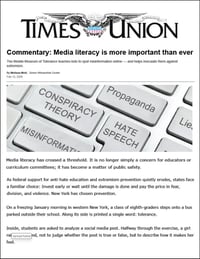 Media literacy has crossed a threshold. It is no longer simply a concern for educators or curriculum committees; it has become a matter of public safety.
As federal support for anti-hate education and extremism prevention quietly erodes, states face a familiar choice: Invest early or wait until the damage is done and pay the price in fear, division, and violence. New York has chosen prevention.
On a freezing January morning in western New York, a class of eighth-graders steps onto a bus parked outside their school. Along its side is printed a single word: tolerance.
Inside, students are asked to analyze a social media post. Halfway through the exercise, a girl raises her hand, not to judge whether the post is true or false, but to describe how it makes her feel.
“It’s trying to make me angry,” she says. “Like it wants me to react right away.”
That recognition is the lesson, and it is the moment where prevention quietly begins.
Nearly every state, including New York, now mandates media literacy education. Yet misinformation, propaganda and online radicalization move faster than any curriculum can chase. The problem is not that young people fail to recognize misinformation. It is that they are saturated by it.
What’s missing is not awareness. It is capacity.
Extremism rarely begins with ideology. It begins with emotion: fear, humiliation, outrage, the desire to belong. Online, those emotions are amplified and weaponized long before reflection has time to intervene. Teaching students to identify falsehoods after the fact is insufficient if we do not also teach them how manipulation feels and how it works.
Rather than waiting for harm and responding after the fact, New York has invested in prevention by bringing media literacy and historical context directly into communities through a mobile, community-based learning model. The premise is simple: Resistance to extremism is built through practice, not prohibition. Students don’t just learn what misinformation looks like; they learn how it operates, how language accelerates urgency, how narratives exploit grievance and how emotion can override judgment.
This approach reflects what researchers increasingly understand about modern extremism. Hate movements today are interconnected, braiding antisemitism, misogyny, racism and conspiracy into emotionally charged narratives. What draws people in is rarely doctrine at first. It is the sense that something is broken and that someone else is to blame.
That is why prevention must happen early, before belief hardens and before outrage becomes action.
There is precedent for this strategy. In the 1990s, following a surge in neo-Nazi violence, Germany began treating extremism less as a law enforcement problem and more as a public health challenge. Mobile advisory teams met communities where they were, in schools, workplaces and congregations, focusing on early intervention rather than punishment. New York’s approach reflects a similar logic, adapted for a digital age.
In 2024, the Simon Wiesenthal Center’s Museum of Tolerance launched the first Mobile Museum of Tolerance: a traveling classroom that invites young people to study, reflect upon and ask questions about online and digital hate.
In 2025, this initiative reached schools in 81 state Senate and Assembly districts, rural and urban, Republican- and Democrat-represented alike. Participation is not driven by ideology. Schools opt in because parents and educators share a basic concern: that students leave school better equipped to navigate a world where manipulation is constant and belonging can be weaponized.
Inside the mobile classroom, sessions are intentionally restrained: interactive, brief and focused on process rather than conclusions. Facilitators do not tell students what to think. They ask them to notice when language sharpens, when fear rises and when identity is used to divide.
One facilitator shares his own childhood experience of being forced from his home in Kosovo after government propaganda cast his community as criminals. Violence did not come first. It came after language and repetition prepared the ground.
Research supports this model. Studies show that interventions that simulate manipulation, rather than simply exposing people to extremist ideas, significantly increase individuals’ ability to recognize and resist recruitment. Like a vaccine, the goal is preparedness, not avoidance.
In a digital environment where radicalization often begins with a feeling rather than a belief, public safety may depend on teaching young people to recognize what they are feeling before someone else decides what that feeling should mean. That is not abstract theory; it is a daily reality playing out in classrooms across New York.
Melissa Mott is Executive Vice President for Education Strategy, Programming and Impact at the Simon Wiesenthal Center.